The Snake is the sixth animal of the Chinese zodiac, and its year is the one just ending. The Wood Snake year, January 29, 2025 to February 16, 2026, closes as this guide is published, and the Horse year opens the next day. That timing is the reason to print this guide now: readers who spent the year hearing about the Snake, and Snake-born readers who spent it wearing red through their ben ming nian, have the same question, which is what the sign actually is. The rest of this guide is the answer as the tradition gives it: the years, the five element variants, the temperament, and the compatibility map against all eleven other animals, plus the one story that made the Snake the most romantic animal in the zodiac.
A word on how to read this page before the tables start. Everything here is reported as zodiac tradition, the way teachers, almanac writers, and compatibility authors present it. A birth-year animal is a calendar label with centuries of commentary attached, not a measurement of a person. The guide keeps that frame throughout, and the limits section at the end says where the tradition stops.
Are you a Snake?
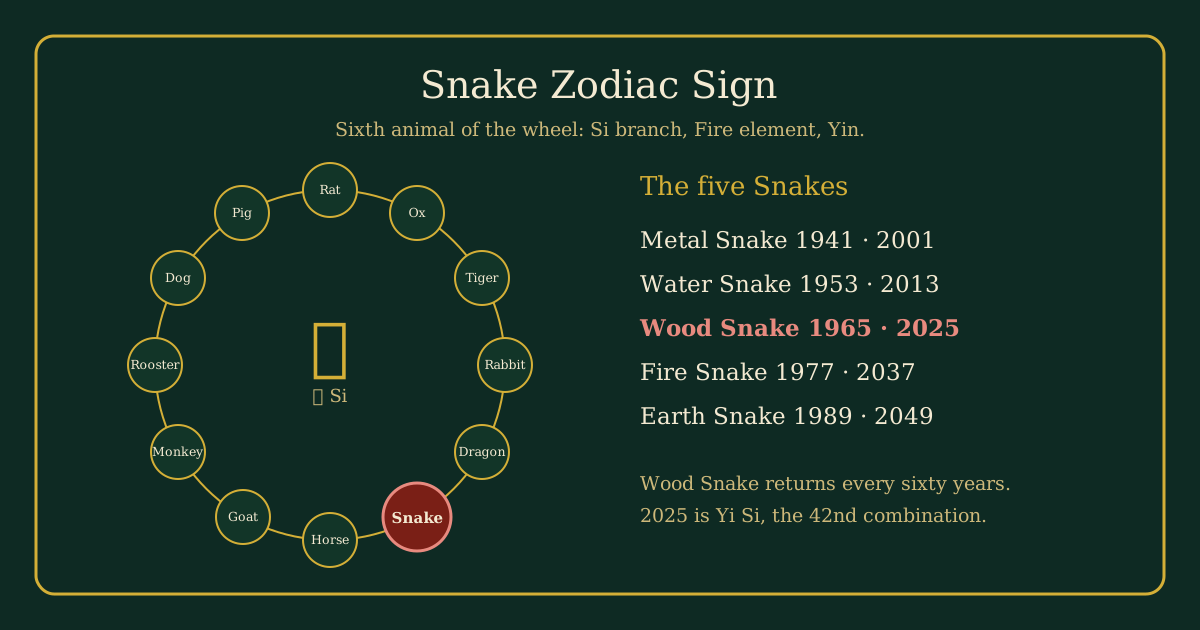
The Snake comes around every twelve years, and each return carries one of the five elements in turn, on a sixty-year cycle. The table below gives every Snake year from 1905 to 2037 with its exact lunar range, its stem-branch name, and its element. The dates follow the English Wikipedia Snake (zodiac) entry, which prints the same ranges from 1929 onward, cross-checked against the TravelChinaGuide Snake page, which prints the same ranges from 1941 onward; the two earlier rows, 1905 and 1917, follow the Lunar New Year date lists, which agree with each other and with the boundaries in the Horse-year table on this site. The stem names follow the standard sexagenary cycle.
| Snake year | Lunar range | Stem-branch | Element |
|---|---|---|---|
| 1905 | Feb 4, 1905 - Jan 24, 1906 | Yi Si | Wood |
| 1917 | Jan 23, 1917 - Feb 10, 1918 | Ding Si | Fire |
| 1929 | Feb 10, 1929 - Jan 29, 1930 | Ji Si | Earth |
| 1941 | Jan 27, 1941 - Feb 14, 1942 | Xin Si | Metal |
| 1953 | Feb 14, 1953 - Feb 2, 1954 | Gui Si | Water |
| 1965 | Feb 2, 1965 - Jan 20, 1966 | Yi Si | Wood |
| 1977 | Feb 18, 1977 - Feb 6, 1978 | Ding Si | Fire |
| 1989 | Feb 6, 1989 - Jan 26, 1990 | Ji Si | Earth |
| 2001 | Jan 24, 2001 - Feb 11, 2002 | Xin Si | Metal |
| 2013 | Feb 10, 2013 - Jan 30, 2014 | Gui Si | Water |
| 2025 | Jan 29, 2025 - Feb 16, 2026 | Yi Si | Wood |
| 2037 | Feb 15, 2037 - Feb 3, 2038 | Ding Si | Fire |
Two catches decide whether the table gives you the right animal. The first is the January and February boundary. The zodiac year turns at Lunar New Year, not on January 1, so a birth in January or early February usually belongs to the previous animal. A baby born on January 20, 2025 is a Dragon, not a Snake; a baby born on January 30, 2025 is a Snake. The birth-year chart on this site prints the cutover dates year by year for exactly this check, and its worked example uses that same January 20, 2025 birth.
The second catch is the school split. Most popular writing draws the line at Lunar New Year. Some BaZi schools draw it at Lichun, the Start of Spring solar term, which falls around February 4. The two lines can disagree by up to a fortnight, so a birth in late January or the first days of February can be a Dragon under one school and a Snake under the other. For most birthdays it makes no difference. Near the boundary, check both, and know which line the source you are reading used.
One more distinction the table invites, because it confuses more readers than any other point in the zodiac. The Snake is a Fire sign in every Snake year, by its branch. The year element in the table comes from the stem, and it changes each return. A Metal Snake is a Metal year on a Fire animal, not a Metal animal. The elements guide on this site works through the three layers that get tangled here: the branch element that never changes, the stem element that gives the year its name, and the nayin sound element that sits underneath both.
A Snake year also carries a nickname the other animals do not get. It is sometimes called a Little Dragon Year, a softening of the animal for people born in it, recorded in Diana Lary's study of Chinese grandmothers and cited in the Wikipedia entry. The Dragon is the sign everyone wants; the Snake, the Dragon's smaller cousin, gets the compliment by association.
The five Snakes
Five elements, five Snake variants, each returning every sixty years. The character notes below follow the TravelChinaGuide Snake page, which prints a short description for each element Snake, reported as such. The one-line version, as that page prints it: Metal Snakes are decisive, Water Snakes are adaptable, Wood Snakes are cooperative, Fire Snakes are charismatic, and Earth Snakes are reliable.
Metal Snake: 1941, 2001, and 2061
Xin Si. Metal on Fire, a year element that the branch element works on, since Fire melts Metal. The tradition reads Metal Snakes as the most decisive of the five: the Snake's careful planning with a harder edge, strong-willed and blunt in speech, competitive in a way the other variants are not. Writers credit them with the fastest decisions of the five and the clearest sense of what they want, and they list the same directness turning harsh under pressure, saying the plain thing at the wrong moment. A Metal Snake born in 2001 is 25 in 2026; one born in 1941 is 85.
Water Snake: 1953, 2013, and 2073
Gui Si. Water on Fire, the year element that controls the branch element, since Water puts out Fire. The tradition reads Water Snakes as the most adaptable: the Snake's caution with a lighter step, flexible, persuasive, and sociable, quicker to change course when a plan is not working. Writers describe them as the variant most at home in a room full of strangers and most comfortable talking their way through a problem, and they list the same adaptability turning into drift, a lack of long-term focus when nothing holds them to one course. A Water Snake born in 2013 is 13 in 2026.
Wood Snake: 1965, 2025, and 2085
Yi Si. Wood on Fire, the year element that feeds the branch element, since Wood feeds Fire. The tradition reads Wood Snakes as the most cooperative: the Snake energy pointed outward toward people and shared projects, creative, gentle, and artistic, steadier in company than alone. Writers describe them as the variant most likely to build something with others rather than guard it alone, and they list the same openness turning into dependence, leaning too much on other people's opinions before deciding. A Wood Snake born in 1965 is 61 in 2026; one born in 2025 is 1.
Fire Snake: 1917, 1977, 2037, and 2097
Ding Si. Fire on Fire, stem and branch the same element, the 54th combination of the sixty-year cycle. The tradition reads Fire Snakes as the most intense of the five, and the description is consistent across references: passionate, charismatic, impatient, a natural leader. The same writers who praise the energy warn about it in the same breath: quick to flare, quick to take charge, and hard to slow down. The next Fire Snake year is 2037, which opens on February 15 that year.
Earth Snake: 1929, 1989, 2049, and 2109
Ji Si. Earth on Fire, the year element the branch element creates, since Fire creates Earth. The tradition reads Earth Snakes as the most practical: the Snake's depth with its feet closer to the ground, steady, reliable, and patient with routine, better at finishing than starting. Writers describe them as the variant most comfortable with responsibility and with work that repeats, and they list the same steadiness turning stubborn, resistant to change even when the change is plainly needed. An Earth Snake born in 1989 is 37 in 2026.
Where the Snake sits on the wheel
The Snake is sixth of twelve, between Dragon and Horse, with the Earthly Branch Si, 巳. Its fixed element is Fire, its polarity Yin. The branch never changes, whatever the year element says. A Snake born in a Water year is still a Fire sign by branch, and the year table above is a list of Fire animals wearing five different year elements.
The position comes with two stories. In the Jade Emperor's race, the legend this site retells animal by animal in the race guide, the Snake knew it could not swim well enough to win, so it hid on the Horse's hoof for the crossing and slid off just before the finish, startling the Horse and taking sixth place. The story gives the Snake its traditional character sketch in one scene: quiet, patient, and willing to let a louder animal do the carrying. The other story runs the other way. In the drought legend TravelChinaGuide retells, the Jade Emperor sent the Snake down to help people dying of thirst, and the Snake did not pray for rain. It taught people to dig wells, build reservoirs, and save water, and the Emperor gave it a place among the twelve for the work. One story says the Snake wins by stealth. The other says it earns its place by solving a problem. The tradition carries both, and the tension between them is the sign in miniature.
The branch also owns a slice of the day and the year. The Snake double-hour, Si hour, runs from 9:00 am to 11:00 am, the late-morning block when the sun warms the earth and, as the Wikipedia entry puts it, snakes are said to slither out of their holes. The Snake lunar month is the fourth lunar month, the Si month, which falls in May to June. The Wikipedia entry lists the season as spring, which sits oddly against a fourth-month sign that falls in May and June; the month and the hour are the parts of the assignment every source agrees on, so this guide prints those and leaves the season label with the entry that carries it. In BaZi work the hour branch is the fourth pillar of a chart, so a person born between 9:00 and 11:00 am carries Snake in the hour pillar as well, and the birth-hour guide on this site works through all twelve double-hours and what the tradition reads into each one.
Temperament in tradition
The site's own zodiac data gives the short version, and it matches what the references print: the Snake is complex, intuitive, and philosophical, the deepest thinker of the zodiac, with a quiet wisdom. Strengths: wise, intuitive, graceful, determined. Weaknesses: jealous, suspicious, cold. That four-and-three list is the spine. The fuller picture, as compatibility writers fill it in, runs as follows.
Snakes observe more than they express. They watch a room before they speak in it, read people quickly, and keep their conclusions private until they need them, which gives them the air of mystery the writing always mentions. A Snake at a dinner party listens to three conversations before joining one, and when it speaks, the remark lands because it was thought through first. That is the stock scene in the writing, and it is worth reporting because it recurs in reference after reference.
The pace is the rest of the picture. Snakes plan carefully before acting, rely on wisdom and strategy rather than force, and stay calm under pressure, which makes them the people others turn to in a crisis. The shadow side is the same caution seen from the other side: secrecy that reads as coldness, suspicion that keeps people at a distance, jealousy in love that demands more loyalty than a partner can comfortably give, and hesitation that waits for the perfect moment until the moment has passed. Difficulty trusting quickly is the weakness the writers list most often after jealousy.
Read as a whole, the tradition's Snake is a sign built for depth and patience, and the advice the tradition gives Snake people is always the same shape: trust the intuition, but say the plan out loud sooner, and act before the perfect moment becomes a missed one. The work section below follows that advice into careers. None of it is a claim about any real Snake-born person. It is a character sketch the tradition has carried for centuries, and the test of it is whether readers recognise the sketch, not whether the sketch proves anything.
Compatibility with all eleven animals
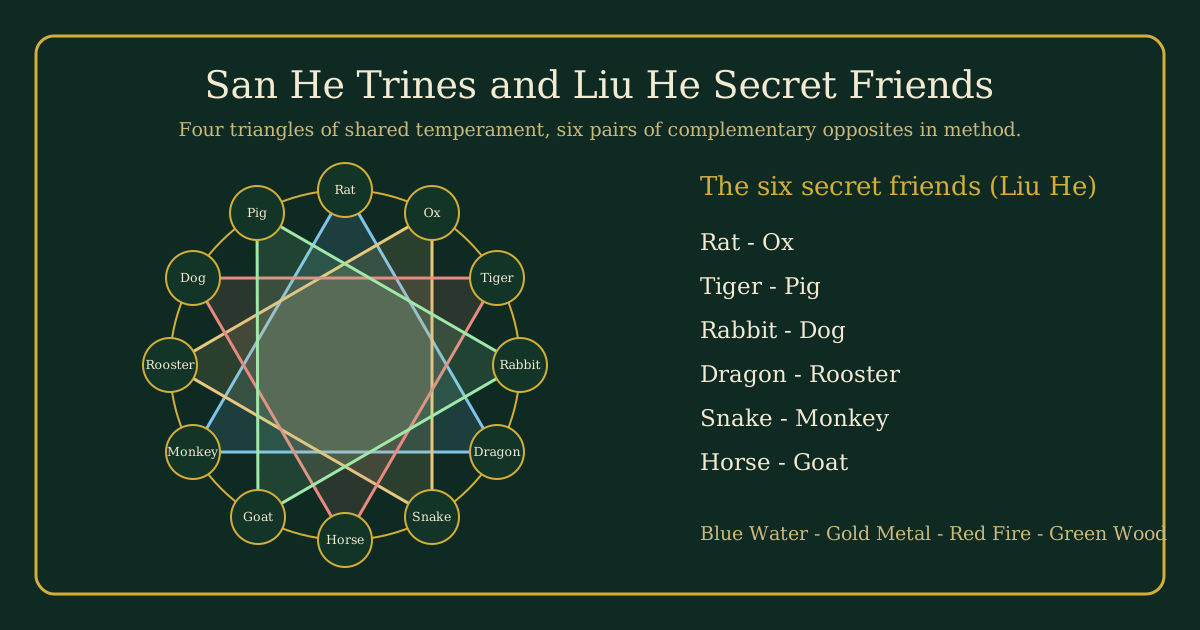
The Snake's relationship map comes from two sources that have to be kept apart: the branch relations, which are geometry, and the temperament writing, which is opinion. The branch relations are fixed. Snake trine allies are Ox and Rooster. Snake secret friend is Monkey. Snake clash opposite is Pig. Snake harm partner is Tiger. Snake is a member of the Tiger-Snake-Monkey punishment trio, and Monkey is also listed as a destruction partner for Snake. Everything else is a pair with no named branch relation, which the tradition reads as neutral ground where temperament does the work.
| Partner | Branch relation | The tradition reading |
|---|---|---|
| Rat | No named relation | Moderate in the popular charts. Different speeds: Rat quick and acquisitive, Snake slow and deliberate, with no branch friction between them. |
| Ox | Trine ally, San He | Best match. Shared Metal-trine temperament: endurance, calm, and precision. Ox steadiness gives the Snake the space it wants, and the Snake's judgement steadies the Ox in return. |
| Tiger | Harm, and punishment trio | The hard match. Tiger bold and impulsive against Snake calm and strategic, and the harm relation adds interference on top of the clash of pace. The old marriage verse warns against the pair. |
| Rabbit | No named relation | Moderate in the popular charts. Both animals are passive in the writing, which can turn quiet into dull over time, and the pair needs one of them to start things. |
| Dragon | No named relation | Moderate in the popular charts. Both have strong personalities and may compete for control, which is the one friction the writing names for this pair. |
| Snake | Same sign | Double watchfulness. Two Snakes understand each other's privacy and depth, and the same privacy can leave both waiting for the other to speak first. |
| Horse | No named relation | Moderate in the popular charts. Snake calculation against Horse impulse, a pairing the writing treats as workable rather than easy. |
| Goat | No named relation | Moderate in the popular charts. Goat gentleness suits the Snake's pace, but Goat indecision frustrates the strategic Snake, and the pair needs one decisive voice. |
| Monkey | Secret friend, Liu He, and destruction partner, and punishment trio | Best match, with a complication. Monkey liveliness draws out the Snake's cheerful side, and Monkey perception senses when a Snake feels uneasy. The same pair is also a destruction pair and shares the Tiger-Snake-Monkey punishment trio, which is why some charts flag it. The trines guide on this site calls this pair the standard exhibit for why no single list should be read alone. |
| Rooster | Trine ally, San He | Best match. Shared Metal-trine temperament: both value refinement and order, Snake reserved and Rooster expressive, a contrast the writing says attracts rather than repels. |
| Dog | No named relation | Quiet pair. The lists say little about it beyond the absence of friction, which is itself the reading: nothing in the branch system stands between them. |
| Pig | Clash, six places apart | The classic opposition. Pig open and straightforward against Snake complex and reserved, Fire against Water, the hardest pairing in the branch tables. |
The site's own zodiac data agrees with the table's shape: best matches Monkey, Rooster, and Ox; worst matches Pig and Tiger. The one row to handle carefully is Monkey. A reader who finds a popular chart calling Snake and Monkey the best match and this guide also calling it a destruction pair has found a real stacking of relations between two branches, not an error in either list. The secret-friend relation is a harmony pairing, built for couples. The destruction relation and the punishment trio are chart relations, built for readings. The trines guide and the harms and punishments guide on this site set out both layers and show how to stack them, and the love compatibility guide turns the stack into questions a couple can actually discuss. Read the branch tables for the system. Read the love guide for the relationship.
Work in tradition
The careers the tradition attaches to the Snake follow directly from the temperament: work that rewards strategy, analysis, and patience. The list TravelChinaGuide prints most often is finance, law, psychology, research, design, and diplomacy, with the calm nature making Snakes excellent negotiators and crisis managers. The through-line is depth: work where a careful read of a situation matters more than speed, with a small loyal team rather than a large noisy one.
The same writers list the work Snakes struggle in, and it is the mirror image: roles with aggressive bosses, constant public performance, and decisions that have to be made before the facts are in. Snakes are credited with missing opportunities by overthinking them, and the advice the tradition gives is to take calculated risks and trust the intuition more, rather than waiting for the perfect moment. Metal Snakes, the most decisive variant, are credited with handling pressured decisions better than the other four. Water Snakes are credited with the easiest time in rooms full of strangers, which is consistent with the element portraits above.
Treat the list as the tradition's job board, not a career counsellor. It describes where the sign's stock character fits the shape of a job, and it says nothing about any real person's skills, training, or prospects. A Snake-born salesperson who loves a noisy room is not a contradiction of the system. The system was never a test.
The White Snake: the legend that made the sign romantic
No other zodiac animal carries a love story as large as the Snake's. The Legend of the White Snake (白蛇传, Bai She Zhuan) is counted as one of China's Four Great Folktales, alongside Lady Meng Jiang, the Butterfly Lovers, and the Cowherd and the Weaver Girl, and it has been retold in every medium the culture has: storyteller scripts, novels, opera, film, and animation.
The story, in the form most people know it, is a romance between a man named Xu Xian and a female snake spirit named Bai Suzhen, a white snake who has taken human form. They meet, marry, and live as husband and wife until a monk, Fahai, exposes her true identity and imprisons her under the Leifeng Pagoda by West Lake in Hangzhou. In the telling, Bai Suzhen floods the Jinshan Temple to rescue her husband, fails, and is sealed away, and in the later versions the ending softens: her son grows up, the pagoda falls, and the family is reunited. The arc of the legend is the arc of its heroine, from demon to devoted wife, and the telling changed as the culture changed around it.
The paper trail is unusually complete, and the Wikipedia entry on the legend prints it in order. The oldest surviving related story is "Li Huang", a Tang dynasty tale in the Boyi zhi collection, set in the year 807, in which a beautiful woman in white turns out to be a white snake and the man who meets her dies horribly. The story that formed the legend as a legend, "The Three Pagodas of West Lake", appeared in the Ming dynasty Jiajing era, 1541 to 1551, as a storyteller's script. The pivot came in 1624, when Feng Menglong printed "Madam White Is Kept Forever Under the Thunder Peak Tower" in his collection Stories to Caution the World, replacing the eating of livers with theft and turning the snake sympathetic. The name Bai Suzhen appears for the first time in the 1809 tanci The Righteous Demons, and the Qing dynasty operas finished the transformation, making Fahai the villain and the snake the heroine.
The legend travelled. In 1956, on the orders of Zhou Enlai, a Peking opera troupe led by Mei Lanfang performed it in Japan, and the same year Toho released The Legend of the White Serpent, Japan's first colour special-effects film. In 1958 Toei released The White Snake Enchantress, Japan's first colour feature-length animated film, and the story became familiar to the Japanese public. A calendar animal that began as a symbol of wisdom and suspicion had become, through one story, the zodiac's great romantic lead, and the Snake's reputation in the tradition carries both halves: the cool strategist of the compatibility charts and the devoted wife of the legend, who floods a temple for the man she loves.
Lucky associations, and why the lists disagree
No section of a zodiac profile generates more confident lists, and none deserves more caution. Published Snake lucky lists agree with each other more than the Horse lists did, but they still disagree, and a guide that prints one of them as the answer is hiding the disagreement. The table below prints three lists side by side, with sources named, so the disagreement is visible.
| Association | English Wikipedia, Snake (zodiac) | TravelChinaGuide Snake page | This site, lucky colours by animal |
|---|---|---|---|
| Lucky numbers | 2, 8, 9 | 2, 8, 9; unlucky 1, 6, 7 | Not listed |
| Lucky colours | Red, yellow, black; avoid white, gold, brown | Red, yellow, black; unlucky blue, dark green, white | Black, red, yellow |
| Lucky flowers | Orchid, cactus | Orchid, cactus, daisy | Not listed |
| Lucky directions | Not listed | Southeast, southwest, northeast; avoid northwest | Not listed |
Read the table row by row and the pattern is plain. The two number lists agree exactly, 2, 8, and 9, and the site's own zodiac data prints the same three numbers. The colour lists agree on red, yellow, and black, and this site's own colours guide gives the same three in a different order. Orchid and cactus are the two flowers both outside lists share. The disagreement is narrow but real: one list tells readers to avoid gold and brown, another tells them to avoid blue and dark green, and the two avoid-lists share only white.
There is one more disagreement, and it sits inside this site's own data rather than between outside lists. The zodiac page's luck-cures field for Snake gives green and silver as the colours, while one outside list counts dark green among the unlucky colours. The colours guide on this site and both outside lists agree on black, red, and yellow, so a reader choosing colours for a New Year outfit or a wedding has a better basis in that agreement than in any single field. A reader choosing numbers for a lottery ticket has no basis at all, and no list on this page should be used as one.
Snake-born figures
The people below were born in Snake years, with the birth month falling inside the lunar range in the year table above. The list is factual: name, birth date, and the Snake variant that year carries. It is not a claim that the sign made them who they were. Two of the rows are worth reading closely, because they show the boundary rule doing its work: Muhammad Ali was born on January 17, 1942, before that year's Lunar New Year on February 14, so he belongs to the Metal Snake year that began on January 27, 1941, not to the Horse year that followed. Oprah Winfrey was born on January 29, 1954, before that year's Lunar New Year on February 2, so she belongs to the Water Snake year that began on February 14, 1953. Both are January births that the year alone would misfile.
| Person | Born | Snake year |
|---|---|---|
| Audrey Hepburn | May 4, 1929 | Earth Snake |
| Muhammad Ali | January 17, 1942 | Metal Snake |
| Bob Dylan | May 24, 1941 | Metal Snake |
| J.K. Rowling | July 31, 1965 | Wood Snake |
| Emmanuel Macron | December 21, 1977 | Fire Snake |
| Taylor Swift | December 13, 1989 | Earth Snake |
| Billie Eilish | December 18, 2001 | Metal Snake |
| Oprah Winfrey | January 29, 1954 | Water Snake |
The first five rows follow the famous-people list on the TravelChinaGuide Snake page, which prints the same names, dates, and variants. The list leans, as such lists do, toward people who moved audiences through performance, writing, and public presence, which is the Snake sketch in its most flattering form: quiet people who command a room without raising their voices. It also includes two Metal Snakes born a year apart in the same cycle, Dylan and Ali, which is the twelve-year cycle doing its ordinary work: same stem-branch, same element, two very different lives.
A worked example, labelled hypothetical
The person below is invented for this guide. The birth month is chosen to sit clear of the New Year boundary, and the point is the order of the checks, which is the same order a traditional reader works in.
The person. A hypothetical birth in May 1989.
Step 1, find the animal and the element. 1989 is a Snake year, running February 6, 1989 to January 26, 1990, and May sits safely inside it. The stem is Ji, Earth, so this is an Earth Snake: an Earth year on a Fire animal. The element portrait above applies: the most practical variant, the Snake's depth with its feet closer to the ground.
Step 2, the trine and secret friend. Snake trine allies are Ox and Rooster, the Metal trine. Snake secret friend is Monkey. In the tradition reading, the person shares a temperament with Ox and Rooster people and finds the closest single complement in Monkey, with the complication noted in the compatibility table: Monkey is also a destruction partner and a member of the same punishment trio.
Step 3, the friction sweep. Snake clash opposite is Pig. Snake harm partner is Tiger. Snake is a member of the Tiger-Snake-Monkey punishment trio, so the pattern needs Tiger and Monkey branches alongside the Snake to complete, and a single Snake in the year pillar does not activate it. None of those relations describes this person alone; they describe pairs, and they matter when another person's animal enters the picture.
Step 4, the year cycle. A Snake person meets their own animal every twelve years: 2001, 2013, 2025, 2037. Those are the ben ming nian years, covered in the ben ming nian guide. 2025 was one of them, and it is also a Wood Snake year, so a 1989 Earth Snake meeting 2025 met their own animal in its Wood form. The next is 2037, a Fire Snake year. The tradition treats those years as ones to move carefully in. It does not treat them as predictions.
The reading. Worked through all four steps, the hypothetical person is an Earth Snake with Metal-trine allies, a Monkey secret friend carrying a stacked relation, two named friction partners for pairing checks, and a ben ming nian just passed in 2025. What that describes, in the tradition's own language, is a calendar position and the commentary centuries of writers have attached to it. What it does not do is describe the invented person, whose life the example never touches, or predict anything about any real person born in May 1989, whose full chart would add month, day, and hour branches that change every answer here.
Ben ming nian: the Snake's own year
2025 was a ben ming nian year for Snake people, and it arrived in its Wood form, since the returning animal was a Wood Snake. In the tradition, the customs are the familiar ones: red clothing and accessories worn through the year, a lower profile on big decisions, and attention to the Tai Sui side of the same year, since the year's Grand Duke is the Snake itself. The ben ming nian guide covers the customs, the red-underwear tradition, and the Tai Sui afflictions in full, and the Fire Goat 2027 guide picks up the story where 2026 ends, on February 6, 2027. For the year's feng shui side, the Flying Stars 2027 guide carries the annual chart forward. The 2026 predictions for Snake people on this site covers the year after the ben ming nian in the almanac's own terms, and the Wood Snake forecast covers the year that is ending from the feng shui side.
Limits, stated plainly
The lists in this guide were checked three ways before they were printed: against the wheel geometry itself, where trines must sit four apart and the clash, harm, and destruction relations must agree row by row with this site's own clash and harms guides; against the year table in the English Wikipedia Snake (zodiac) entry, which gives the same lunar ranges and elements from 1929 onward, with the two earlier rows checked against the Lunar New Year date lists; and against the site's own zodiac data, whose best and worst matches for Snake agree with the table above. Where published lists disagree, on lucky colours and on the Snake-Monkey stacking, the disagreement is printed rather than resolved.
The harder limit is the standing one for this pillar. No evidence shows that a birth-year animal, an element variant, or a pairing measures anything about a real person or a real relationship. The systems describe patterns inside their own geometry, a calendar that acquired a psychology over centuries of commentary, and the descriptions are consistent because the geometry is consistent, not because the psychology has been tested. The White Snake legend is the exception that proves the rule in the other direction: the one measurable effect in this guide, a story retold for twelve centuries across every medium, was caused by people believing the system, not by the system being right. Two people are not a pair of branches, and no table on this page should be used to hire, fire, choose, or refuse anyone.
Sources and further reading
The Snake-year table with lunar ranges, stems, and elements follows the English Wikipedia entry Snake (zodiac), read for this guide, which prints the same ranges from 1929 to 2097; the 1905 and 1917 rows follow the Lunar New Year date lists, which agree with each other and with the boundaries in this site's Horse-year table. The Snake hour, the fourth lunar month, the race story, the fixed Fire element, the Yin polarity, the lucky numbers 2, 8, and 9, the lucky colours red, yellow, and black, the orchid and cactus flowers, the second trine with Ox and Rooster, the Pig as most incompatible, and the Little Dragon Year nickname follow the same entry. The element character notes, the career list, the temperament descriptions, the compatibility tiers, the famous-people list, and the drought legend follow the TravelChinaGuide Snake page, read for this guide, cross-checked against this site's own zodiac data for Snake, which gives the same strengths, weaknesses, and best and worst matches. The lucky-number and colour lists are printed as published: English Wikipedia for 2, 8, and 9 with red, yellow, and black; TravelChinaGuide for the same numbers and colours with daisy added to the flowers and southeast, southwest, and northeast as the directions; and this site's lucky colours by animal guide for black, red, and yellow. The branch relations for Snake, trine Ox and Rooster, secret friend Monkey, clash Pig, harm Tiger, destruction Monkey, and the Tiger-Snake-Monkey punishment trio, follow this site's trines guide, clash guide, and harms and punishments guide, which share the wheel and must agree row by row. The race story follows this site's Jade Emperor's race guide. The White Snake history, the Four Great Folktales count, the 807 Tang tale, the 1541-1551 storyteller script, the 1624 Feng Menglong pivot, the 1809 first use of the name Bai Suzhen, and the 1956 and 1958 Japan crossings follow the English Wikipedia entry Legend of the White Snake, read for this guide.