The Horse is the seventh animal of the Chinese zodiac, and 2026 is its year. Not just any Horse year, either. 2026 is a Fire Horse year, Bing Wu, the pairing that comes around once every sixty years and last arrived in 1966, when it cut Japan's birth rate by a quarter. That story is below, with the numbers as the demographers recorded them. The rest of this guide is the sign itself: the years, the five element variants, the temperament as the tradition prints it, and the compatibility map against all eleven other animals.
A word on how to read this page before the tables start. Everything here is reported as zodiac tradition, the way teachers, almanac writers, and compatibility authors present it. A birth-year animal is a calendar label with centuries of commentary attached, not a measurement of a person. The guide keeps that frame throughout, and the limits section at the end says where the tradition stops.
Are you a Horse?
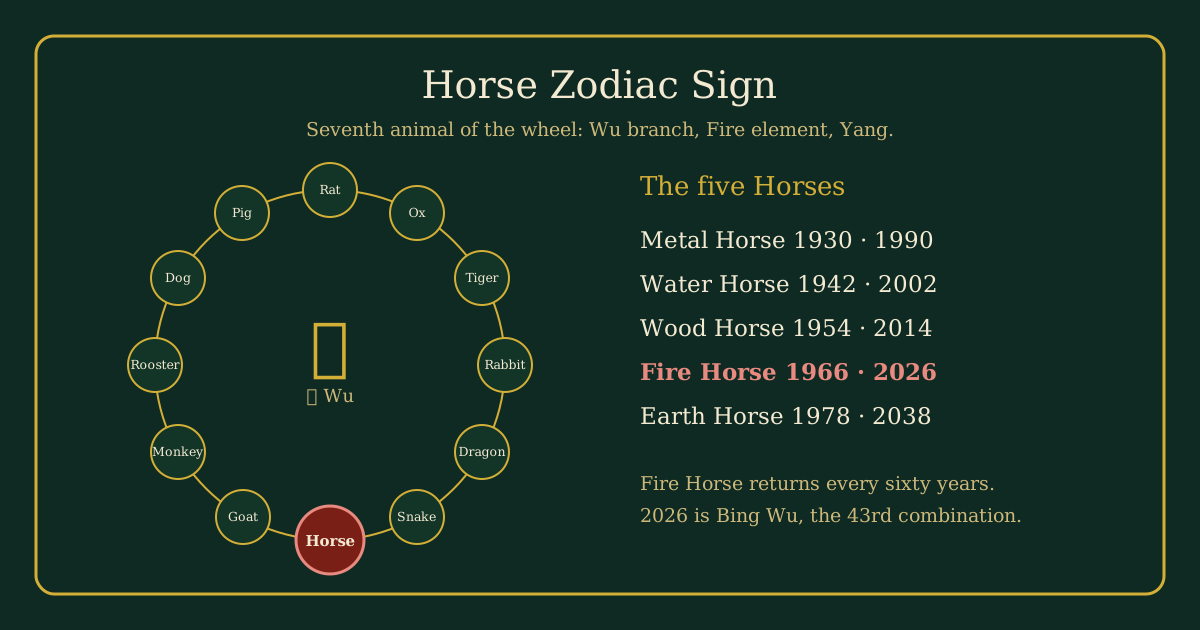
The Horse comes around every twelve years, and each return carries one of the five elements in turn, on a sixty-year cycle. The table below gives every Horse year from 1906 to 2038 with its exact lunar range, its stem-branch name, and its element. The dates follow the English Wikipedia Horse (zodiac) entry, which prints the same ranges, and the stem names follow the standard sexagenary cycle.
| Horse year | Lunar range | Stem-branch | Element |
|---|---|---|---|
| 1906 | Jan 25, 1906 - Feb 12, 1907 | Bing Wu | Fire |
| 1918 | Feb 11, 1918 - Jan 31, 1919 | Wu Wu | Earth |
| 1930 | Jan 30, 1930 - Feb 16, 1931 | Geng Wu | Metal |
| 1942 | Feb 15, 1942 - Feb 4, 1943 | Ren Wu | Water |
| 1954 | Feb 3, 1954 - Jan 23, 1955 | Jia Wu | Wood |
| 1966 | Jan 21, 1966 - Feb 8, 1967 | Bing Wu | Fire |
| 1978 | Feb 7, 1978 - Jan 27, 1979 | Wu Wu | Earth |
| 1990 | Jan 27, 1990 - Feb 14, 1991 | Geng Wu | Metal |
| 2002 | Feb 12, 2002 - Jan 31, 2003 | Ren Wu | Water |
| 2014 | Jan 31, 2014 - Feb 18, 2015 | Jia Wu | Wood |
| 2026 | Feb 17, 2026 - Feb 5, 2027 | Bing Wu | Fire |
| 2038 | Feb 4, 2038 - Jan 23, 2039 | Wu Wu | Earth |
Two catches decide whether the table gives you the right animal. The first is the January and February boundary. The zodiac year turns at Lunar New Year, not on January 1, so a birth in January or early February usually belongs to the previous animal. A baby born on February 10, 2026 is a Snake, not a Horse; a baby born on February 20, 2026 is a Horse. The birth-year chart on this site prints the cutover dates year by year for exactly this check.
The second catch is the school split. Most popular writing draws the line at Lunar New Year. Some BaZi schools draw it at Lichun, the Start of Spring solar term, which falls around February 4. The two lines can disagree by up to a fortnight, so a birth in late January or the first days of February can be a Snake under one school and a Horse under the other. For most birthdays it makes no difference. Near the boundary, check both, and know which line the source you are reading used.
One more distinction the table invites, because it confuses more readers than any other point in the zodiac. The Horse is a Fire sign in every Horse year, by its branch. The year element in the table comes from the stem, and it changes each return. A Metal Horse is a Metal year on a Fire animal, not a Metal animal. The elements guide on this site works through the three layers that get tangled here: the branch element that never changes, the stem element that gives the year its name, and the nayin sound element that sits underneath both.
The five Horses
Five elements, five Horse variants, each returning every sixty years. Compatibility writers print a short character note for each one, and the notes below are those published descriptions, reported as such. The one-line version, as several references print it: Metal Horses are the most disciplined, Water Horses the most communicative, Wood Horses the most collaborative, Earth Horses the most practical, and Fire Horses the most intense.
Metal Horse: 1930, 1990, and 2050
Geng Wu. Metal on Fire, a year element that controls the branch element in the generating cycle, since Fire melts Metal and Metal is what Fire works on. The tradition reads Metal Horses as the most disciplined of the five: the Horse drive aimed at a fixed target, with more patience for structure than the sign usually shows. Writers credit them with sharper focus, a stronger sense of timing, and a willingness to finish what they start, and they list the same discipline turning rigid under pressure. A Metal Horse born in 1990 is 36 in 2026; one born in 1930 is 96.
Water Horse: 1942, 2002, and 2062
Ren Wu. Water on Fire, the year element that controls the branch element, since Water puts out Fire. The tradition reads Water Horses as the most communicative: the Horse social energy with a cooler head, better at listening than the sign reputation suggests, and quicker to change course when a plan is not working. Writers describe them as adaptable and persuasive, the Horse variant most at home in negotiation and in rooms full of strangers, and they list the same adaptability turning into restlessness when nothing holds their attention. A Water Horse born in 2002 is 24 in 2026.
Wood Horse: 1954, 2014, and 2074
Jia Wu. Wood on Fire, the year element that feeds the branch element, since Wood feeds Fire. The tradition reads Wood Horses as the most collaborative: the Horse energy pointed outward toward people and projects shared with others, generous with time and credit, and steadier in groups than alone. Writers describe them as friendly and idealistic, the variant most likely to build a team around an idea, and they list the same openness turning into overcommitment, saying yes to more than one Horse can carry. A Wood Horse born in 2014 is 12 in 2026.
Fire Horse: 1906, 1966, 2026, and 2086
Bing Wu. Fire on Fire, stem and branch the same element, the 43rd combination of the sixty-year cycle. The tradition reads Fire Horses as the most intense of the five, and the description is consistent across references: bold, magnetic, headstrong, restless to a degree the other variants do not reach. The same writers who praise the energy warn about it in the same breath: quick to flare, quick to move on, hard to slow down. Fire Horse years carry a superstition of their own, strong enough to move a national birth rate, and it gets a full section below because it is the one place where this sign's folklore left a mark in demographic records.
Earth Horse: 1918, 1978, 2038, and 2098
Wu Wu. Earth on Fire, the year element the branch element creates, since Fire creates Earth. The tradition reads Earth Horses as the most practical: the Horse drive with its feet closer to the ground, more patient with routine, better at finishing, and slower to chase the next thing. Writers describe them as steady and realistic, the variant most comfortable with responsibility and with work that repeats, and they list the same steadiness turning cautious when a risk is worth taking. An Earth Horse born in 1978 is 48 in 2026, and the next Earth Horse year, 2038, opens on February 4 that year.
Where the Horse sits on the wheel
The Horse is seventh of twelve, between Snake and Goat, with the Earthly Branch Wu, 午. Its fixed element is Fire, its polarity Yang. The branch never changes, whatever the year element says. A Horse born in a Metal year is still a Fire sign by branch, and the year table above is a list of Fire animals wearing five different year elements.
The position comes with a story. In the Jade Emperor's race, the legend this site retells animal by animal in the race guide, the Horse was a fine runner and looked certain of sixth place. It had crossed the river cleanly and was galloping for the line when the Snake, which had hidden itself on the Horse's hoof for the whole crossing, slid off, startled the Horse, and slithered across ahead of it. The Horse took seventh. The story gives the Horse its traditional character sketch in one scene: fast, open, and easily startled, beaten not by a faster runner but by a quieter one.
The branch also owns a slice of the day and the year. The Horse double-hour, Wu hour, runs from 11:00 am to 1:00 pm, the midday block, which fits a Fire sign. The Horse lunar month is the fifth lunar month, the Wu month, and the season the references assign the sign is summer. In BaZi work the hour branch is the fourth pillar of a chart, so a person born between 11:00 am and 1:00 pm carries Horse in the hour pillar as well, and the birth-hour guide on this site works through all twelve double-hours and what the tradition reads into each one.
Temperament in tradition
The site's own zodiac data gives the short version, and it matches what the references print: the Horse represents energy, independence, and enthusiasm. Strengths: energetic, independent, warm-hearted, positive. Weaknesses: impatient, hot-tempered, self-centred. That four-and-three list is the spine. The fuller picture, as compatibility writers fill it in, runs as follows.
Horses communicate openly and often. They tell stories, make friends quickly, and fill silences, and the social energy is described as genuine rather than performed: Horses feed off the stimulation of other people. A Horse walks into a dinner party, introduces itself to strangers within five minutes, and has the table laughing before dessert. That is the stock scene in the writing, and it is worth reporting because it recurs in reference after reference.
The pace is the rest of the picture. Horses make decisions fast, change course fast, and expect others to keep up. They rarely hold grudges, because they move on emotionally as quickly as they move geographically, and arguments fade within hours rather than lingering for weeks. The shadow side is the same speed seen from the other side: impatience with slow-moving colleagues and family members, a tendency to start many projects and finish few, financial impulsivity, especially on travel, and restlessness that strains long-term commitments. Difficulty listening when energised is the weakness the writers list most often after impatience.
Read as a whole, the tradition's Horse is a sign built for movement and variety, and the advice the tradition gives Horse people is always the same shape: find work and company that change, and build in the pauses the sign does not build in for itself. The work section below follows that advice into careers. None of it is a claim about any real Horse-born person. It is a character sketch the tradition has carried for centuries, and the test of it is whether readers recognise the sketch, not whether the sketch proves anything.
Compatibility with all eleven animals
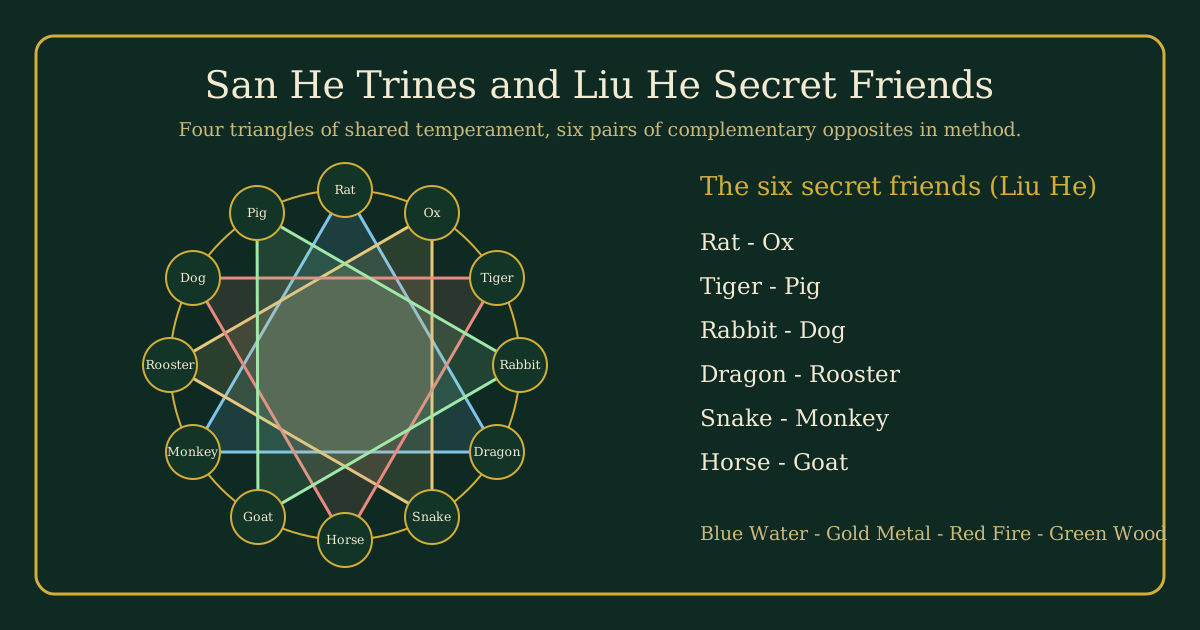
The Horse's relationship map comes from two sources that have to be kept apart: the branch relations, which are geometry, and the temperament writing, which is opinion. The branch relations are fixed. Horse trine allies are Tiger and Dog. Horse secret friend is Goat. Horse clash opposite is Rat. Horse harm partner is Ox. Horse destruction partner is Rabbit. Horse is a self-punishment branch, so the punishment pattern needs a second Horse to activate. Everything else is a pair with no named branch relation, which the tradition reads as neutral ground where temperament does the work.
| Partner | Branch relation | The tradition reading |
|---|---|---|
| Rat | Clash, six places apart | The classic opposition. Rat caution and planning against Horse spontaneity, the hardest pairing in the branch tables. |
| Ox | Harm | Interference rather than head-on opposition. Ox steadiness reads as a brake on Horse movement, and the old marriage verse warns against the pair. |
| Tiger | Trine ally, San He | Best match. Shared Fire-trine temperament: courage, drive, appetite for the open. The adventurous partnership of the writing. |
| Rabbit | Destruction | The split pair. The branch tables list Rabbit as a destruction partner for Horse, while popular charts call the match moderate. The branch reading is the stricter one. |
| Dragon | No named relation | Moderate in the popular charts. Different scales, Dragon at vision range and Horse at speed, with no branch friction between them. |
| Snake | No named relation | Moderate in the popular charts. Snake calculation against Horse impulse, a pairing the writing treats as workable rather than easy. |
| Horse | Same sign | Double energy. Self-punishment needs a second Horse to activate, so two Horses in one chart, or a Horse year meeting a Horse person, is read as the sign turned up, not as a verdict. |
| Goat | Secret friend, Liu He | Best match. Drive steadied: Horse runs, Goat gentleness is read as turning a sprint into a journey the pair finishes together. |
| Monkey | No named relation | Moderate in the popular charts. Monkey improvisation against Horse momentum, with no branch relation to settle the question either way. |
| Rooster | No named relation | The odd one. No branch friction, yet both this site's zodiac data and the popular charts list Rooster among the Horse's hard matches, on temperament: Rooster precision and caution against Horse speed. |
| Dog | Trine ally, San He | Best match. Loyalty with shared values, the pairing the writing credits with outlasting more conventionally compatible matches. |
| Pig | No named relation | Quiet pair. The lists say little about it beyond the absence of friction, which is itself the reading: nothing in the branch system stands between them. |
The site's own zodiac data agrees with the table's shape: best matches Tiger, Goat, and Dog; worst matches Rat, Ox, and Rooster. The one row to handle carefully is Rabbit. A reader who finds a popular chart calling Horse and Rabbit a moderate match and this guide calling it a destruction pair has found a real disagreement between two layers of the tradition, not an error in either list. The destruction relation is a branch-table relation, built for chart work. The moderate rating is a temperament judgment, built for couples. The trines guide and the harms and punishments guide on this site set out both layers and show how to stack them, and the love compatibility guide turns the stack into questions a couple can actually discuss. Read the branch tables for the system. Read the love guide for the relationship.
Work in tradition
The careers the tradition attaches to the Horse follow directly from the temperament: work that rewards movement, variety, and communication. The list compatibility writers print most often is travel journalism and foreign correspondence, photography, field sales and international accounts, sports as athlete, trainer, or journalist, entertainment including stand-up comedy, radio, and podcasting, event planning and hospitality management, entrepreneurship, especially serial founder roles, and military operations and emergency response. The through-line is change: work that changes weekly, with people around who change quarterly.
The same writers list the work Horses struggle in, and it is the mirror image: corporate middle management with rigid hierarchies, clerical work without variety, and research positions requiring multi-year focus on a single narrow question. Metal Horses, the most disciplined variant, are credited with handling structured careers better than the other four. Fire Horses are credited with needing the most variety, which is consistent with the element portraits above.
Treat the list as the tradition's job board, not a career counsellor. It describes where the sign's stock character fits the shape of a job, and it says nothing about any real person's skills, training, or prospects. A Horse-born accountant who loves routine is not a contradiction of the system. The system was never a test.
The Fire Horse year and 1966
This is the one section of the guide where folklore left a mark that can be counted. Fire Horse, Bing Wu, is the 43rd combination of the sixty-year cycle: Yang Fire stem over the Fire Horse branch. It arrives every sixty years. The recent ones are 1906, 1966, and 2026.
The superstition, as it is recorded in Japan, holds that a woman born in a Fire Horse year has a strong temperament, shortens her husband's life, and brings ruin to her family. It is traced to the Edo period, to the story of Yaoya Oshichi, a teenager believed to have been born in the Fire Horse year 1666 and executed in 1683 for setting a fire meant to reunite her with her lover. Whether Oshichi was born in 1666 is disputed in the sources themselves: one biography puts her at 16 at her death, which fits a 1666 birth, while East Asian age reckoning would put her at 18. The superstition does not depend on the fact. It depends on the story, and the story stuck.
In 1906, the first Fire Horse year of the modern era, Japan's births fell about 4% from the previous year, and some families reported boys' births as shifted to the year before or after. Around 1924, when the women born in 1906 reached marriageable age, newspapers ran stories denying the superstition alongside reports of suicides by women whose marriage proposals had been broken off over it. The novelist Ango Sakaguchi, himself born in 1906, was given the name Heigo, meaning Fire Horse, and wrote about being told by relatives that it was lucky he had been born a man. He predicted the superstition would not go away.
In 1966 it came back at full strength. Japan's birth rate dropped 25% from the previous year, and the number of births fell to 1,360,974, extremely low against the years around it, while births in 1965 and 1967 rose. Couples avoided having children or had abortions, especially in rural and regional areas, and the sex ratio at birth tilted, which demographers read as parents misreporting daughters' birth years to 1965 or 1967. The fertility rate, about 2.0 to 2.1 children per woman through the 1960s, dropped to 1.6 in 1966 alone and rebounded the year after, as if half a million births had simply been deferred by twelve months. The effect was strong enough that local governments campaigned against it: in November 1965 the Yamagata District Legal Affairs Bureau sponsored a Fire Horse Banishment Campaign with a parade, after consultations about childbearing led to divorce settlements and harassment from neighbours, and the city of Kurume called the belief a fairy tale in its public relations paper.
The women who were born in 1966 anyway grew up to have measurably lower marriage rates than the cohorts on either side, and lower income levels and poorer educational outcomes. The research on this point is careful about the cause. The disadvantage came from the discrimination the superstition created, not from the year. Employers, matchmakers, and families treated the 1966 cohort differently because of the label, and the label did the damage the label predicted. It is the cleanest demonstration in the zodiac's history of a belief harming the people it describes, and the harm is the belief's, not the year's.
The next Fire Horse year is 2026. The World Bank, writing on the 1966 numbers, speculated that the trend will not continue in 2026. Japan in 2026 is not Japan in 1966: birth rates are already low, sex detection during pregnancy is routine, and the superstition is widely known as a superstition. Whether the speculation holds is a question for the demographic record, not for this guide. What the record already shows is that a calendar label, believed hard enough, can move half a million births by a year, and that the people who pay for it are the ones born under it.
Lucky associations, and why the lists disagree
No section of a zodiac profile generates more confident lists, and none deserves more caution. Published Horse lucky lists disagree with each other, sometimes on the same item, and a guide that prints one of them as the answer is hiding the disagreement. The table below prints three lists side by side, with sources named, so the disagreement is visible.
| Association | English Wikipedia, Horse (zodiac) | Globerove Horse profile | This site, lucky colours by animal |
|---|---|---|---|
| Lucky numbers | 1, 4, 5, 7, 9; avoid 2, 3, 6 | 2, 3, 7; unlucky 1, 5, 6 | Not listed |
| Lucky colours | Gold, yellow, red, blue; avoid orange, green, dark green | Brown, yellow, purple; unlucky blue, white | Yellow, green, red |
| Lucky flowers | Sunflower, jasmine | Calla lily, jasmine | Not listed |
| Lucky directions | Not listed | Northeast, southwest, east | Not listed |
Read the table row by row and the pattern is plain. The two number lists agree on exactly one number, 7, and contradict each other on 1, 2, 3, 5, and 6. The colour lists agree on yellow and contradict each other on green, which one list calls lucky and another tells readers to avoid, and on blue, which one list calls lucky and another calls unlucky. Jasmine is the one flower both outside lists share. Yellow is the one colour all three lists share.
There is no canonical list to appeal to. Almanac traditions vary by region, by school, and by publisher, and the lists get copied, recombined, and reprinted until their disagreements look like errors in one source rather than what they are: different traditions. This site's own colours guide gives Horse years yellow, green, and red, and that is the palette this site uses consistently. A reader choosing colours for a New Year outfit or a wedding has a better basis in that consistency than in any single outside list. A reader choosing numbers for a lottery ticket has no basis at all, and no list on this page should be used as one.
Horse-born figures
The people below were born in Horse years, with the birth month falling inside the lunar range in the year table above. The list is factual: name, birth year, and the Horse variant that year carries. It is not a claim that the sign made them who they were.
| Person | Born | Horse year |
|---|---|---|
| Theodore Roosevelt | October 1858 | Earth Horse |
| Nelson Mandela | July 1918 | Earth Horse |
| Paul McCartney | June 1942 | Water Horse |
| Aretha Franklin | March 1942 | Water Horse |
| Denzel Washington | December 1954 | Wood Horse |
| Kobe Bryant | August 1978 | Earth Horse |
| Emma Watson | April 1990 | Metal Horse |
The list leans, as such lists do, toward people who moved audiences and history through movement and communication, which is the Horse sketch in its most flattering form. It also includes two Earth Horses, Roosevelt and Mandela, born sixty years apart, which is the sixty-year cycle doing its ordinary work: same stem-branch, same element, two very different lives.
A worked example, labelled hypothetical
The person below is invented for this guide. The birth month is chosen to sit clear of the New Year boundary, and the point is the order of the checks, which is the same order a traditional reader works in.
The person. A hypothetical birth in May 1990.
Step 1, find the animal and the element. 1990 is a Horse year, running January 27, 1990 to February 14, 1991, and May sits safely inside it. The stem is Geng, Metal, so this is a Metal Horse: a Metal year on a Fire animal. The element portrait above applies: the most disciplined variant, the Horse drive aimed at a fixed target.
Step 2, the trine and secret friend. Horse trine allies are Tiger and Dog, the Fire trine. Horse secret friend is Goat. In the tradition reading, the person shares a temperament with Tiger and Dog people and finds the closest single complement in Goat.
Step 3, the friction sweep. Horse clash opposite is Rat. Horse harm partner is Ox. Horse destruction partner is Rabbit. None of those relations describes this person alone; they describe pairs, and they matter when another person's animal enters the picture. For this one person, the sweep to run is the self-punishment check: Horse is a self-punishment branch, but the pattern needs a second Horse in the chart, in a luck pillar, or in a passing year, so a single Horse in the year pillar does not activate it.
Step 4, the year cycle. A Horse person meets their own animal every twelve years: 2002, 2014, 2026, 2038. Those are the ben ming nian years, covered in the ben ming nian guide. 2026 is one of them, and it is also a Fire Horse year, so a 1990 Metal Horse meeting 2026 meets their own animal in its most intense form. The tradition treats that as a year to move carefully in. It does not treat it as a prediction.
The reading. Worked through all four steps, the hypothetical person is a Metal Horse with Fire-trine allies, a Goat secret friend, three named friction partners for pairing checks, and a ben ming nian in 2026. What that describes, in the tradition's own language, is a calendar position and the commentary centuries of writers have attached to it. What it does not do is describe the invented person, whose life the example never touches, or predict anything about any real person born in May 1990, whose full chart would add month, day, and hour branches that change every answer here.
Ben ming nian: the Horse's own year
2026 is a ben ming nian year for Horse people, and it arrives in its strongest form, since the returning animal is a Fire Horse. In the tradition, the customs are the familiar ones: red clothing and accessories worn through the year, a lower profile on big decisions, and attention to the Tai Sui side of the same year, since the year's Grand Duke is the Horse itself. The ben ming nian guide covers the customs, the red-underwear tradition, and the Tai Sui afflictions in full, and the Fire Goat 2027 guide picks up the story where 2026 ends, on February 6, 2027. For the year's feng shui side, the Flying Stars 2027 guide carries the annual chart forward.
Limits, stated plainly
The lists in this guide were checked three ways before they were printed: against the wheel geometry itself, where trines must sit four apart and the clash, harm, and destruction relations must agree row by row with this site's own clash and harms guides; against the year table in the English Wikipedia Horse (zodiac) entry, which gives the same lunar ranges and elements; and against the site's own zodiac data, whose best and worst matches for Horse agree with the table above. Where published lists disagree, on lucky numbers and colours, the disagreement is printed rather than resolved.
The harder limit is the standing one for this pillar. No evidence shows that a birth-year animal, an element variant, or a pairing measures anything about a real person or a real relationship. The systems describe patterns inside their own geometry, a calendar that acquired a psychology over centuries of commentary, and the descriptions are consistent because the geometry is consistent, not because the psychology has been tested. The 1966 story is the exception that proves the rule in the other direction: the one measurable effect in this guide was caused by people believing the system, not by the system being right. Two people are not a pair of branches, and no table on this page should be used to hire, fire, choose, or refuse anyone.
Sources and further reading
The Horse-year table with lunar ranges, stems, and elements follows the English Wikipedia entry Horse (zodiac), read for this guide, which prints the same ranges from 1906 to 2098; the stem-branch names follow the sixty-year cycle as printed in the same entry and in the Fire Horse entry. The Fire Horse superstition, the 1906 and 1966 birth figures, the Yaoya Oshichi origin, and the 2026 note follow the English Wikipedia entry Fire Horse, read for this guide, which gives 1,360,974 births in 1966 and a 25% birth-rate drop, and the World Bank blog The curse of the Fire-Horse, which gives the fertility-rate fall from about 2.0-2.1 to 1.6 and speculates the trend will not continue in 2026. The element character notes, the career list, and the temperament descriptions follow the Globerove Horse profile, read for this guide, cross-checked against this site's own zodiac data for Horse, which gives the same strengths, weaknesses, and best and worst matches. The lucky-number and colour lists are printed as published: English Wikipedia for 1, 4, 5, 7, and 9 with gold, yellow, red, and blue; Globerove for 2, 3, and 7 with brown, yellow, and purple and directions northeast, southwest, and east; and this site's lucky colours by animal guide for yellow, green, and red. The branch relations for Horse, trine Tiger and Dog, secret friend Goat, clash Rat, harm Ox, destruction Rabbit, and self-punishment when doubled, follow this site's trines guide, clash guide, and harms and punishments guide, which share the wheel and must agree row by row. The race story follows this site's Jade Emperor's race guide.