Crystals are the most-bought feng shui object in any shop, and the most mis-sold. Walk into a crystal store and you will find a wall of golden clusters labelled citrine that started life as purple amethyst, pink glass sold as rose quartz, and white resin sold as selenite. The tradition has a placement for each stone. The mineral world has a hardness, a chemistry, and a price for each one. This guide keeps the two apart, so you can place a stone by the tradition and buy it by the facts.
A word on how to read this page before the tables start. Every placement below is reported as feng shui tradition, the way practitioners and shopkeepers present it. Every hardness, composition, and treatment fact is reported as mineralogy, checked against the Gemological Institute of America and the standard Mohs reference. The two kinds of claim sit in different columns for exactly that reason. Nothing here promises wealth, love, health, or protection. The limits section at the end says what the tradition does not claim, and the buying section says what the sellers do not.
The twelve stones
Twelve stones cover nearly every placement in the tradition. The table gives the mineral fact first, then the traditional role, so you can see which half of the row you are reading.
| Stone | What it actually is | Mohs hardness | Traditional role | Usual sector |
|---|---|---|---|---|
| Clear quartz | Silicon dioxide, colourless quartz | 7 | The all-rounder; goes anywhere | Centre, any sector |
| Amethyst | Purple quartz, colour from iron and natural irradiation | 7 | Calm, rest, clear thinking | Centre, bedroom, knowledge |
| Citrine | Yellow-orange quartz | 7 | Wealth, confidence, motivation | Wealth, southeast |
| Rose quartz | Pink quartz, colour from trace titanium and manganese | 7 | Love, compassion, gentleness | Love, southwest |
| Black tourmaline | Tourmaline group, black variety | 7 - 7.5 | Protection, grounding | Entrance, career |
| Jade | Jadeite or nephrite, two different minerals sold under one name | 6.5 - 7 / 6 - 6.5 | Steady growth, wisdom, good conduct | Wealth, family |
| Pyrite | Iron sulfide, metallic gold colour | 6 - 6.5 | Wealth, confidence, boldness | Wealth, fame |
| Tiger's eye | Fibrous quartz, golden-brown bands | 7 | Grounding, courage, clear sight | Knowledge, career |
| Carnelian | Orange chalcedony, a quartz variety | 6.5 - 7 | Drive, warmth, creativity | Fame, creativity |
| Green aventurine | Green quartz, colour from mica flakes | 7 | Opportunity, steady luck, growth | Wealth, family |
| Selenite | Gypsum variety, fibrous and silky | 2 | Clarity, calm, clearing a space | Centre, bedroom |
| Obsidian | Volcanic glass, naturally formed | 5 - 5.5 | Protection, cutting ties, sharp focus | Entrance, career |
Two rows deserve a second look before anything else. Jade is two minerals, not one: jadeite at 6.5 to 7 and nephrite at 6 to 6.5, and the jade of Chinese tradition is historically nephrite, the tougher, more fibrous stone. A seller who says "jade" without saying which is selling a name, not a mineral. And obsidian is natural glass, which is why it sits at 5 to 5.5 while the quartz family sits at 7: it is the one stone on this list that a steel knife can scratch, and its edges are sharp enough to cut, which is why the tradition treats it as a cutting stone and why it belongs in a stand, not loose on a shelf edge.
Clear quartz
Clear quartz is silicon dioxide with nothing in it to colour it, and that plainness is the whole point in the tradition. It is the stone that takes any placement: centre of the home, a desk, a shelf in a sector you have not decided about yet. Practitioners call it an amplifier, meaning it is placed beside other stones to strengthen their role, and that claim is tradition, not measurement. The mineral facts are simpler and more useful. Quartz is hard at 7, it does not fade in sunlight the way amethyst does, it takes water without damage, and it is the stone to learn the buying checks on, because everything that is true of quartz is true of half the list: the same hardness, the same density of 2.65, the same glass test. A tumbled piece the size of a plum is the starter stone, and it is also the stone to buy first if you only buy one.
Amethyst
Amethyst is purple quartz, coloured by iron and by natural irradiation over millions of years, and it is the stone the tradition puts where people rest and think: the bedroom, the reading corner, the knowledge sector in the near left of the bagua. The traditional role is calm, and the placement follows it: bedside table, not the front door. Two mineral facts matter for owning it. First, the purple fades in strong direct sunlight over months, so a windowsill is the wrong home for a deep-coloured piece. Second, the colour zoning is the buying tell: natural amethyst shows lighter and darker purple patches when held to the light, while glass fakes are one flat purple all the way through, and dyed quartz shows colour concentrated in the cracks. Amethyst is also the stone behind the citrine problem, which gets its own section below.
Citrine
Citrine is the yellow-orange variety of quartz, and it is the wealth stone of the tradition: southeast corner, desk, cash box, the place where money is counted. The buying fact comes first here because it decides what you are actually holding. Natural citrine is rare. The Gemological Institute of America states it plainly: because yellow quartz is rare in nature, most citrine on the market is heat-treated amethyst, heated to roughly 470 to 560 degrees Celsius until the purple turns yellow-orange. The treated stone is still genuine quartz, and the tradition, which cares about colour and placement, does not object to it. The price should. Natural citrine is pale, smoky honey, even in colour, and costs more. Heat-treated pieces lean burnt orange, often with a white base where the kiln heat did not reach, and cost less. Ask the seller which one it is. A seller who cannot answer is a seller to walk away from, whatever the stone.
Rose quartz
Rose quartz is pink quartz, coloured by trace titanium and manganese, and it is the love stone of the tradition: southwest corner, bedroom, always in pairs. The pairing is the point. Two tumbled pieces, two hearts, two small spheres on the bedside table, because the tradition reads a single stone in the love sector as a single person, and the pair as the partnership. The mineral fact that decides the buying is the cloudiness. Real rose quartz is milky and translucent, with the pink varying across the piece. Pink glass is clear, or one flat saturated pink, and a strand of beads all the same hot pink is glass until proven otherwise. Rose quartz takes water and takes sunlight better than amethyst, though a deep pink will still soften in a sunny window over a long time. Keep the pair together and dust them together; the tradition treats the pair as one placement, and the practical reason is the same: a pair that lives apart stops reading as a pair.
Black tourmaline
Black tourmaline is the protection stone of the tradition, placed at the entrance and the career sector at the north, and the one stone the tradition puts between the home and the street. The placement is practical as well as symbolic: a heavy dark stone by the door is the first thing a visitor sees and the last thing you see leaving, and it anchors the entrance the way a doormat does. The mineral facts are kind to it. Tourmaline sits at 7 to 7.5 on the Mohs scale, harder than the quartz family, and it does not fade, does not dissolve, and does not mind water. The buying trap is black glass, which is lighter, warmer to the touch, and shows round air bubbles under a magnifier. A rough chunk with visible striations is the safer buy than a polished black sphere, because the striations are the mineral showing its structure and glass has none to show.
Jade
Jade is the stone with the longest history in Chinese tradition, and the one where the name hides the most. Two minerals share the name: jadeite, at 6.5 to 7, and nephrite, at 6 to 6.5. The jade of the old tradition, the carvings, the burial suits, the discs, is nephrite, the tougher and more fibrous of the two. The jade of the modern high-end market is usually jadeite, the brighter green and the more expensive. In feng shui placement both go to the same sectors: wealth in the southeast, family in the east, steady growth rather than sudden gain. The tradition reads jade as the stone of good conduct and steady decisions, and the placement follows that reading: a desk, a study, a shelf where work happens, rather than a display case. The buying rule is the name rule. Ask which mineral it is, jadeite or nephrite, and treat a seller who answers "just jade" the way you would treat a seller who answers "just citrine" without saying heated or natural.
Placement by bagua sector
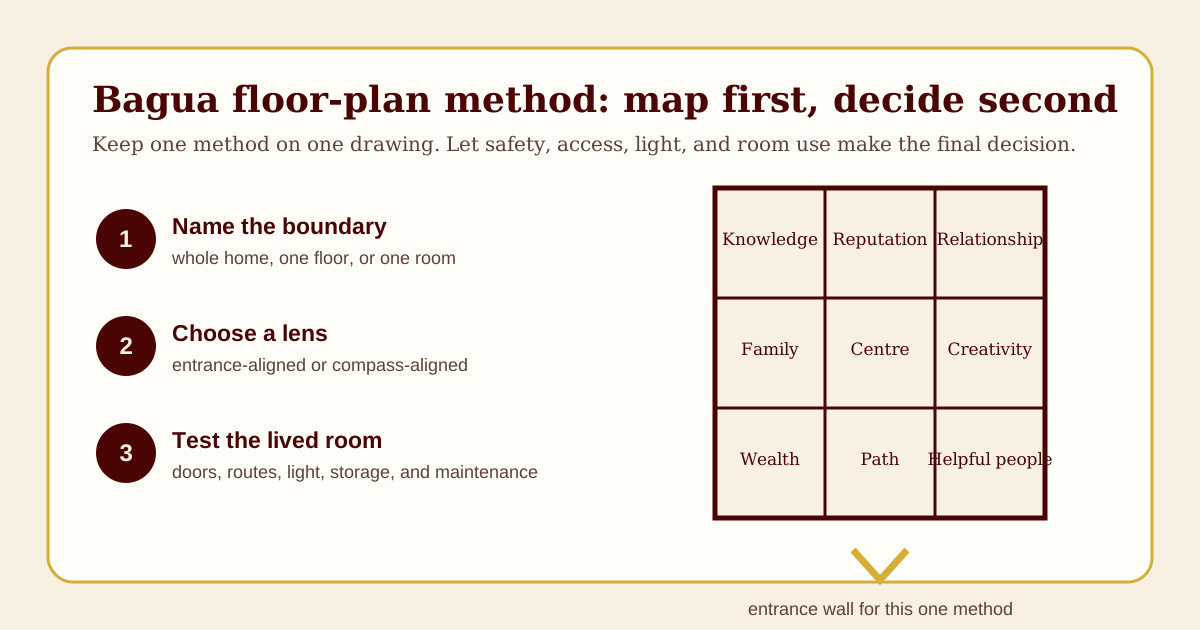
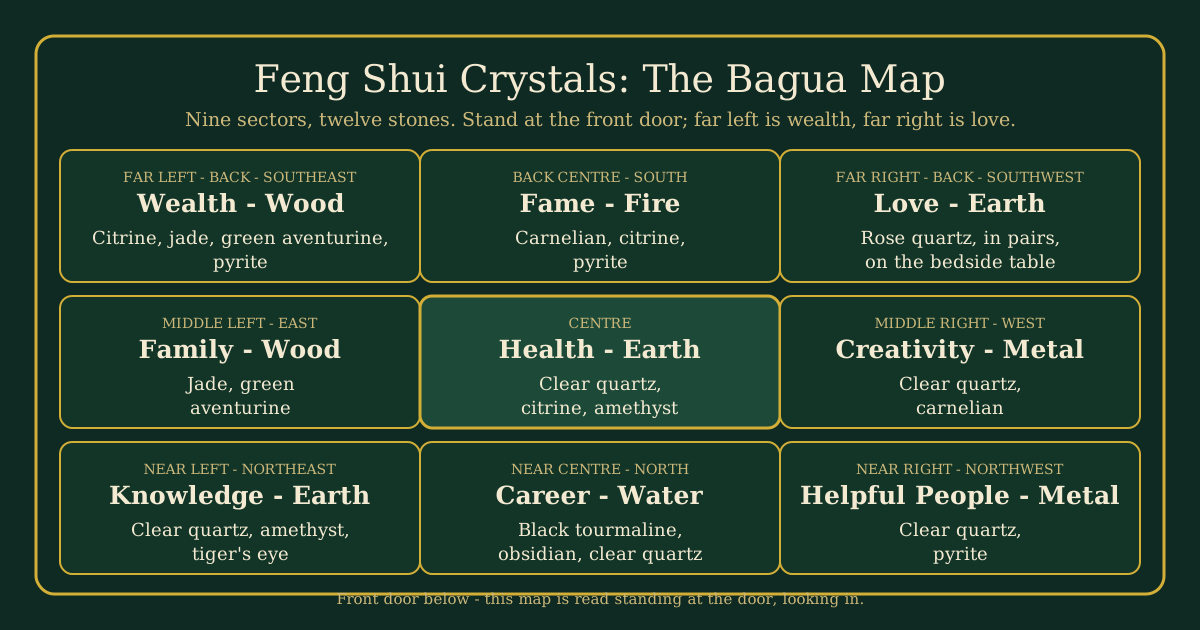
The bagua is the nine-sector grid the tradition lays over a home, and the crystal map follows it. The version used here is the BTB school layout, the one this site's bagua guide teaches: stand at the front door looking in, and the grid runs left to right from there. The far left is wealth, the far right is love, the near centre is career. Pick one school, BTB or compass, and use it for every placement. Mixing the two gives a stone two sectors at once, which is how a placement stops meaning anything.
| Sector | Life area | Element | Stones in tradition | Where it sits |
|---|---|---|---|---|
| Far left, back | Wealth and prosperity | Wood | Citrine, jade, green aventurine, pyrite | Far-left corner of the home or the room |
| Back centre | Fame and reputation | Fire | Carnelian, citrine, pyrite | Back wall, above eye level |
| Far right, back | Love and relationships | Earth | Rose quartz in pairs, rhodonite | Far-right corner, bedroom preferred |
| Middle left | Family and health | Wood | Jade, green aventurine | East wall, living room or dining room |
| Centre | Health and well-being | Earth | Clear quartz, citrine, amethyst | Centre of the home or the room |
| Middle right | Creativity and children | Metal | Clear quartz, carnelian | West wall, studio or play corner |
| Near left | Knowledge and wisdom | Earth | Clear quartz, amethyst, tiger's eye | Study corner, bookshelf |
| Near centre | Career and path | Water | Black tourmaline, obsidian, clear quartz | Entrance wall, hallway, desk facing the door |
| Near right | Helpful people and travel | Metal | Clear quartz, pyrite | Near-right corner, by the phone or the desk |
Three placements carry most of the weight, and they are the three the shops sell most. Citrine in the far-left wealth corner is the classic: a cluster on a shelf, a tumbled piece beside the desk, a small dish of tumbled citrine where money is handled. Rose quartz in pairs in the far-right love corner is the second: two pieces, never one, on the bedside table or the dressing table, where the pair can be seen from the bed. Black tourmaline at the entrance is the third: a rough chunk beside the door, or a pair flanking it, the stone the tradition puts between the household and whatever comes through the door. Start with those three and the rest of the grid is refinement, not requirement.
The centre deserves a note of its own. It is the health sector, and it is also the sector most homes use hardest: the middle of the living room, the dining table, the hallway crossing. A single clear quartz point or sphere in the centre is the standard placement, and it is the one placement that survives every floor plan, because every home has a centre even when the corners are missing. If your home has no clear centre, use the centre of the main living room instead, and say so in your own notes. The tradition is a map, not a building inspector.
Room by room
A sector tells you the corner. A room tells you what the stone has to live with. The same citrine behaves differently on a desk, a kitchen shelf, and a bathroom sill, and the room rules are mostly mineral facts with a traditional frame around them.
Entrance. Black tourmaline or obsidian, one rough chunk beside the door or a pair flanking it. Keep it low and heavy, where it cannot be knocked off a shelf onto a foot, and where it does not block the door swing. The tradition puts protection here, and the practical reason is the same as the symbolic one: the entrance is the first thing the home shows, and a heavy dark stone reads as a threshold.
Living room. The centre of the room takes clear quartz, the far-left corner takes citrine or jade, and a cluster on the coffee table is the standard display piece. Keep points off the seating line: a point aimed at a sofa is a poison arrow in the same tradition that puts the point on the shelf, and a cluster on a low table is a thing children and pets will reach. Spheres roll. Put them in a stand or a shallow dish.
Bedroom. Rose quartz in pairs on the bedside table, amethyst on the same table if sleep is the aim, and nothing large or sharp near the bed. Selenite is the bedroom stone in the modern crystal literature, placed on the windowsill or the bedside table for calm, and the mineral fact to respect is its softness: Mohs 2, scratched by a fingernail, damaged by water, so keep it dry and keep it out of reach of anything that will knock it over. The bedroom is also the room where the tradition is strictest about clutter, and a dozen stones on a dressing table is clutter with a label on it. Two stones, placed with intent, beat a shelf of them. The bedroom guide and the decluttering guide on this site make the same point from the furniture side.
Home office. Citrine or pyrite on the desk for the wealth corner of the desk itself, clear quartz beside the monitor, black tourmaline near the door of the room. The desk is a small bagua of its own: far left of the desk is the desk's wealth corner, near centre is its career edge, and the same nine-sector grid scales down to a desktop. The practical rule is the cable rule: a stone that sits on a cable, blocks a vent, or crowds the keyboard is a stone in the wrong place, whatever the sector says. The desk placement guide on this site works through the desk position itself.
Kitchen and dining room. The kitchen is fire and water in one room, stove against sink, and the tradition keeps stones out of the working triangle: no cluster beside the hob, no tumbled stone in the sink. A small dish of citrine or green aventurine on a dining-room sideboard is the kitchen-adjacent placement, and the dining table itself takes a centrepiece, not a stone. The kitchen guide and the dining room guide on this site set out the room logic that the stones have to fit inside.
Bathroom. Steam and splashes are fine for the quartz family and for jade, and a small tumbled stone on a bathroom shelf is a common placement. Keep selenite, pyrite, and fluorite out: selenite softens in water, pyrite dulls and flakes in damp air, and fluorite at Mohs 4 scratches easily in a room full of hard surfaces. Whatever goes in the bathroom should sit where it cannot fall into the sink or the tub, and it should be a stone you are willing to rinse and dry, because a bathroom stone collects limescale and soap film faster than any other stone in the house.
Matching stones to the five elements
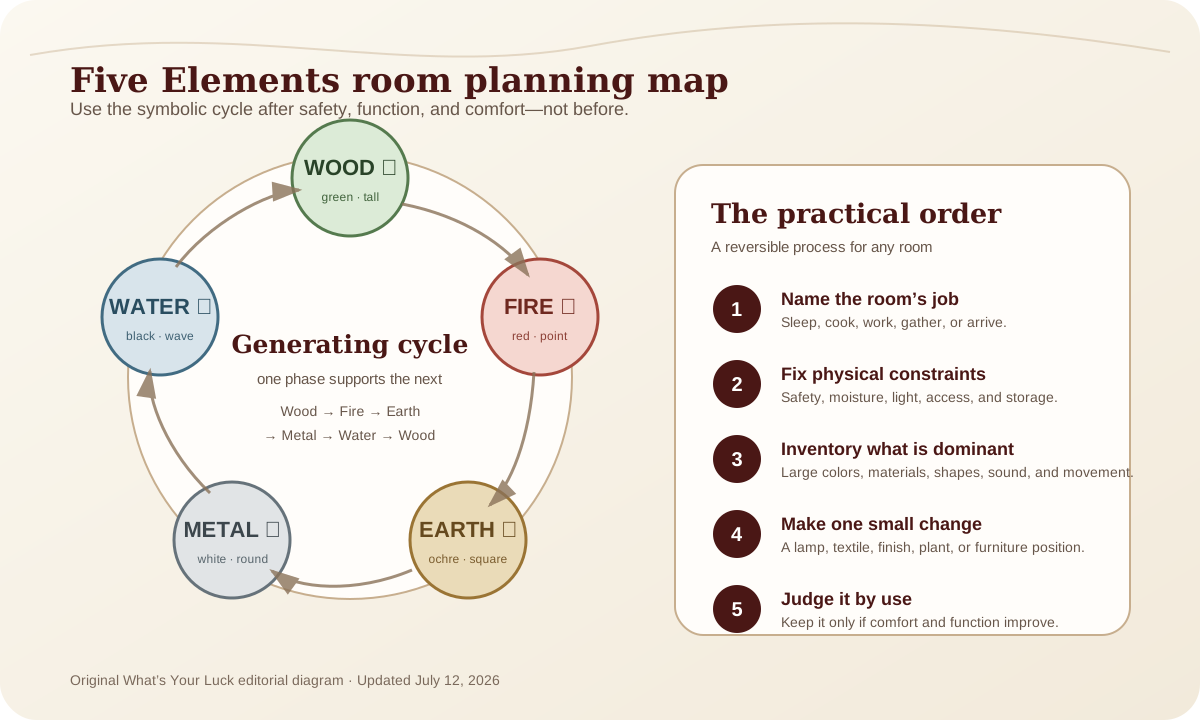
The bagua tells you where a stone goes. The five elements tell you which stone fits a sector that feels flat. The cycle is the same one this site's five elements guide teaches: Wood feeds Fire, Fire creates Earth, Earth bears Metal, Metal collects Water, and Water nourishes Wood. Each element also controls one other: Wood parts Earth, Earth dams Water, Water puts out Fire, Fire melts Metal, and Metal cuts Wood. A stone matches an element by colour and by material, and the match decides whether it feeds the sector or fights it.
| Element | Colour family | Stones | Feeds | Controls |
|---|---|---|---|---|
| Wood | Green | Jade, green aventurine | Fire | Earth |
| Fire | Red, orange | Carnelian, citrine | Earth | Metal |
| Earth | Yellow, brown | Citrine, tiger's eye | Metal | Water |
| Metal | White, metallic | Clear quartz, pyrite | Water | Wood |
| Water | Black, dark blue | Black tourmaline, obsidian | Wood | Fire |
Use the table in two moves. First, feed a weak sector: a wealth corner that feels dead gets Wood stones, jade or green aventurine, because Wood is the wealth element and Wood feeds the Fire of the fame sector beside it. Second, do not flood one element. A desk with citrine, carnelian, and a red candle is three Fires in one place, and the tradition reads excess Fire the way a room reads excess red: loud, tiring, hard to sit with. One stone per element per room is enough, and a room with two elements represented beats a room with five stones of one colour.
The controlling cycle is the repair tool. A career sector that feels stuck, Water, is fed by Metal, so clear quartz or pyrite goes there. A love sector that feels heavy, Earth, is lightened by Wood, so a green stone goes beside the rose quartz rather than a third pink one. The cycle is a diagnostic, not a prescription, and the test of any placement is the room itself: sit in it for a week and see whether the corner reads as finished or as decorated.
Forms: what changes and what doesn't
The same mineral comes in many shapes, and the shape changes the practical life of the stone more than the tradition reads into it. A point, a sphere, and a tumbled piece of the same quartz are the same mineral at the same hardness, and the choice between them is about the room.
Tumbled stones are the beginner form: small, smooth, flat enough to sit anywhere, cheap enough to buy in sets. They are the form for bedside tables, desks, and bathroom shelves, because they do not roll, do not cut, and do not fall far.
Points are the form the tradition reads as directed: a single termination aimed at a door, a window, or a corner. Keep them off the seating line, because a point aimed at a sofa is a poison arrow in the same tradition, and keep them where they cannot be knocked onto a foot. A point on a shelf above eye level, aimed out a window, is the standard placement.
Clusters and geodes are display pieces: heavy, dramatic, and the form most shops push. A citrine cluster in the wealth corner is the classic feng shui photograph, and it is also the heaviest object in this guide. Put it on a shelf rated for its weight, not a floating shelf, and keep it where children cannot pull it down. The weight is the mineral fact. The display is the tradition.
Spheres roll. Every sphere needs a stand or a shallow dish, and a sphere on a sloped surface is a stone on the floor. The tradition reads a sphere as completeness, and the practical reading is the same: a finished shape that belongs in a finished place, a desk, a sideboard, a centre table.
Towers and obelisks stand upright on a flat base and suit the fame sector and the desk, where height reads as ambition in the tradition and as a paperweight in practice. Check the base is flat and the stone is stable before you place it near an edge.
Carvings and gem trees are craft objects: hearts, animals, and small trees of wired stone chips. Rose quartz hearts are the love-sector carving, sold in pairs for the same reason the tumbled stones are paired. Gem trees deserve a closer look before buying: the chips should be stone, not dyed glass or resin, and the test is the same as for any stone, bubbles, hardness, and the cool feel. The tree itself is a display stand, and a tree of glass chips is a glass ornament with a stone price.
Sunlight is the care rule that covers all forms. Amethyst, rose quartz, and citrine all fade in strong direct sunlight over months, amethyst fastest. A sunny windowsill is the wrong home for a deep-coloured piece. Keep coloured quartz out of the window and in the room, where the colour stays and the stone can be seen.
Buying real stone
Most of what goes wrong with crystals goes wrong at the till, not at the placement. The buying checks below are mineral facts, and they work whether or not you believe a word of the tradition.
The citrine problem. Natural citrine is rare, and the Gemological Institute of America says so directly: because yellow quartz is rare in nature, most citrine on the market is heat-treated amethyst, heated to roughly 470 to 560 degrees Celsius until the purple turns yellow-orange. The tells are the colour and the base: treated pieces lean burnt orange with a white base where the kiln heat did not reach, while natural citrine is pale, smoky honey, even in colour. The treated stone is still genuine quartz. It is fine as a wealth-corner stone. What it is not is a natural citrine, and it should not carry a natural citrine price. Ask the seller, in plain words, whether the piece is natural or heat-treated, and buy the answer as much as the stone.
Glass against quartz. Glass is the commonest fake across the whole list, and it fails three checks. Round air bubbles under a magnifier mean glass or resin, because natural quartz never forms them. The cool test: real quartz stays cool against the inside of your wrist for half a minute, glass warms up fast. The hardness test: quartz at Mohs 7 scratches ordinary glass at about 5.5, while glass cannot scratch quartz. Do the scratch check on an inconspicuous edge of a rough piece, never on a polished face, and never on a finished piece you would mind marking. One check proves nothing alone. Three checks together catch most glass.
Dyed quartz. A stone dyed to look like a rarer one shows its colour in the cracks, and an acetone swab on an inconspicuous spot lifts dye off the surface. Dyed agate sold as turquoise and dyed quartz sold as lapis are the usual cases, and a stone whose colour sits only on the outside is a stone that was painted, not grown. The acetone check costs a cotton swab and a minute, and a seller who objects to it is telling you something.
Selenite against alabaster and resin. Real selenite is gypsum at Mohs 2, soft enough to scratch with a fingernail, with a fibrous, silky surface. Alabaster is heavier and harder. Resin warms to the touch within seconds and feels light in the hand. The fingernail test is the quick one: if a fingernail cannot scratch it, it is not selenite.
What to ask before paying. Four questions cover nearly every trap: is this natural or treated, and if treated, how? Which mineral is this, exactly, jadeite or nephrite, quartz or glass? Has it been dyed, coated, or stabilised? And for an expensive piece, is there a lab report from a recognised laboratory such as the GIA or the IGI? A seller who answers all four plainly is a seller worth returning to. A seller who answers none of them is selling the story, not the stone.
Care, and the cleansing customs
The tradition has a cleansing custom for every stone, and the mineral facts decide which custom fits. The customs are running water, moonlight, incense smoke, sound from a bell or singing bowl, and dry salt. The idea behind them is that a stone collects stale energy and needs clearing before it is placed, after a move, or when a room changes. That idea is ritual, not measurement, and this guide reports it as such.
The mineral facts are the guardrails. Selenite is gypsum at Mohs 2 and water damages it, so keep selenite dry and clean it with a soft brush. Pyrite tarnishes in water and in salt, so keep pyrite dry and keep it out of salt bowls. Fluorite and lapis sit at 4 to 6 on the Mohs scale and scratch easily, so keep them away from harder stones in a shared dish. The quartz family, clear quartz, amethyst, citrine, rose quartz, carnelian, green aventurine, and tiger's eye, takes running water without trouble and takes a soft cloth for dust. Sunlight is the other guardrail: the purple and pink quartz varieties fade in strong direct sun, so moonlight, not sunlight, is the light custom for amethyst and rose quartz. When in doubt, use moonlight or sound. Neither harms any stone on this list.
Frequency is a matter of habit, not of rule. The tradition suggests cleansing a new stone before placing it and re-clearing the stones in a room when the room is cleaned or rearranged. A stone that is dusted weekly and moved when the room changes is a stone that is being looked after, and the looking-after is the practice. A stone that sits untouched behind a plant for a year is a stone that has become clutter, and the decluttering guide on this site has the same to say about it as it does about anything else that stops being seen.
A starter set
Three stones, three places, one afternoon. That is the whole starter set, and it is the set to buy before any other.
First, a rough chunk of black tourmaline beside the front door, on the floor or a low shelf, where it anchors the entrance. Second, a pair of tumbled rose quartz on the bedside table, in the southwest of the bedroom where the room allows it. Third, a small tumbled citrine in the far-left corner of the desk, or the far-left corner of the living room if there is no desk. Ask the seller whether the citrine is natural or heat-treated before paying, and pay the heat-treated price if it is heat-treated.
One stone, if the budget is one stone, is clear quartz: a tumbled piece on the desk or in the centre of the home, the all-rounder that fits any sector and any element. Add the second and third stones when the first placement feels finished, not before. A shelf of twelve stones bought in one afternoon is a collection, not a placement, and the tradition has nothing to say about collections.
A worked example, labelled hypothetical
The flat below is invented for this guide. The person is invented too. The point is the order of the checks, which is the same order a traditional reader works in.
The flat. A hypothetical one-bedroom rental, front door opening straight into the living room, bedroom off a short hallway, kitchen at the back. The renter owns no crystals and has a small budget.
Step 1, lay the bagua. The front door is the bottom edge, so the living room grid runs from the door wall: far left is the wealth corner by the balcony door, far right is the love corner by the bedroom door, near centre is the career edge at the door itself. The bedroom gets its own grid, with the bedroom door as its bottom edge and the bedside table in the far-right love corner.
Step 2, place three stones. Black tourmaline goes beside the front door, a rough chunk on the floor where it cannot be kicked. Citrine goes in the far-left corner of the living room, a small tumbled piece on the bookshelf, because the balcony door makes a cluster impractical there. Rose quartz goes in pairs on the bedside table, two tumbled pieces, because the bedside table is the one surface the renter sees every night.
Step 3, run the buying checks. The citrine is burnt orange with a white base, and the seller confirms it is heat-treated amethyst. The renter pays the heat-treated price, which is the correct price for what it is, and places it anyway, because the tradition cares about the colour and the corner. The rose quartz is milky pink with variation across the pieces, no bubbles, cool to the touch. The black tourmaline is a rough chunk with visible striations, heavier than the glass sphere beside it on the shop shelf.
Step 4, the room checks. No point is aimed at the sofa. No stone sits on a cable or blocks a vent. The selenite the shop also offered stays in the shop, because the bathroom is the only spare surface and selenite does not belong in a wet room. The cluster the shop recommended for the wealth corner stays in the shop too, because the bookshelf is a floating shelf and the cluster weighs more than it is rated for.
The result. Three stones, three corners, three checks passed, and a room that reads as finished rather than decorated. What the example does not do is promise anything about the renter's money, love life, or career. It describes a placement, a purchase, and a set of checks, and the value of the exercise is the checks, which work the same way whether the reader believes in the tradition or only in the mineralogy.
Limits, stated plainly
The lists in this guide were checked two ways before they were printed: the placement mapping against three published feng shui crystal guides, which agree on the sector for citrine, rose quartz, and black tourmaline and on the pairing rule for rose quartz, and the mineral facts against the Gemological Institute of America and the standard Mohs reference, which give quartz at 7, glass at about 5.5, selenite at 2, and the heat-treatment facts for citrine. Where the outside lists disagree, on the minor stones and on the centre sector, the disagreement is noted rather than resolved, and the site's own bagua guide and five elements guide are the consistency check for the sectors themselves.
The harder limit is the standing one for this pillar. No evidence shows that a stone in a corner changes health, wealth, or relationships, and no study in this guide claims otherwise. The black tourmaline claim that appears most often in shops, that it absorbs electromagnetic fields from electronics, has no measured effect behind it: a stone beside a router does not change what the router emits, and the placement is a habit, not a shield. A seller who promises outcomes from a stone is selling a claim the tradition does not make, and the buying section above shows how to spot the rest of what that seller is not telling you.
What a stone does, measurably, is sit where it can be seen: a visible reminder of the intention attached to it, a piece of colour and texture in a room, and a small daily practice when it is dusted or moved. That is the value the tradition itself can support, and it is enough to justify three stones in three corners. It is not enough to justify a shelf of twelve, a lab report for a ten-dollar tumbled piece, or any decision about money, health, or a relationship made on the strength of a mineral. Those decisions belong to the people making them, with better evidence than a stone can offer.
Sources and further reading
The citrine treatment facts follow the Gemological Institute of America, which states that natural yellow quartz is rare and most citrine on the market is heat-treated amethyst, heated until the purple turns yellow-orange. The hardness values, quartz at 7, glass at about 5.5, selenite at 2, tourmaline at 7 to 7.5, pyrite at 6 to 6.5, obsidian at 5 to 5.5, and the density of quartz at 2.65, follow the International Gem Society Mohs reference and the USGS mineral guides, as cited in the crystal identification guides read for this piece. The glass, dye, and selenite buying checks follow the same identification guides, which agree on round air bubbles as the glass tell, the cool-feel test, the acetone swab for dye, and the fingernail test for selenite. The sector mapping, citrine to the southeast wealth corner, rose quartz in pairs to the southwest love corner, black tourmaline to the entrance, follows three published feng shui crystal guides read for this guide, which agree on those three placements and on the pairing rule. The bagua sectors and the five-element cycle follow this site's bagua guide and five elements guide, which are the consistency check for every sector and element in the tables above. The room placements follow this site's bedroom guide, desk placement guide, kitchen guide, and decluttering guide.