Short answer
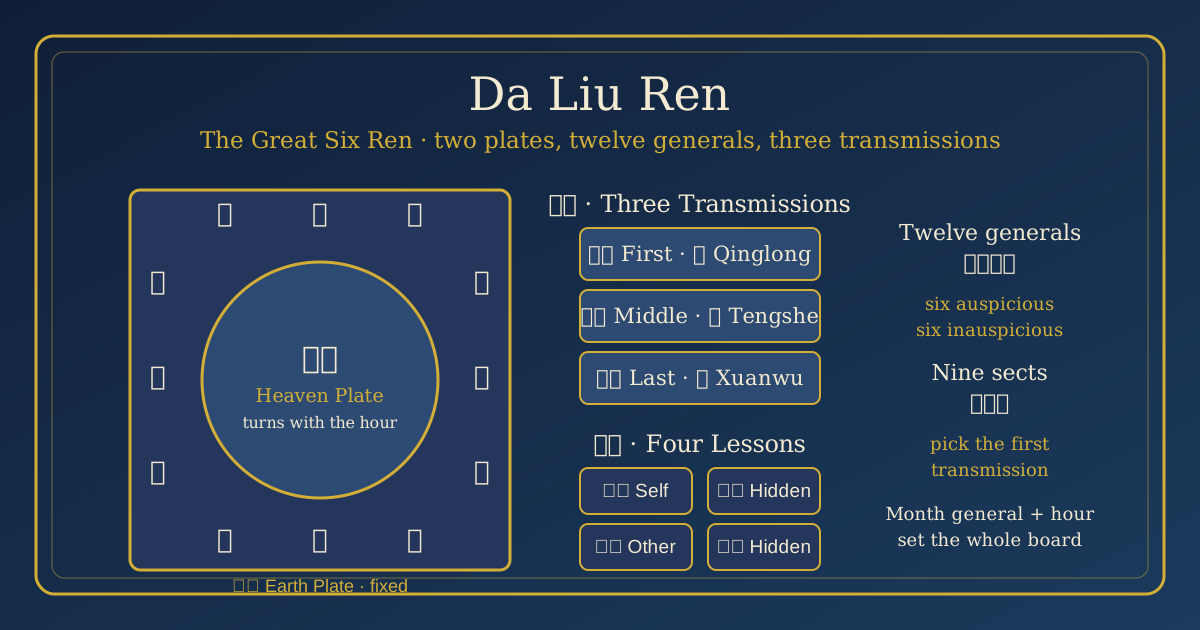
Da Liu Ren (大六壬) is a Chinese divination system that builds a chart for the moment a question is asked. No birth date is needed. The reader takes the day's stem and branch, the month general, and the double-hour, sets a rotating Heaven Plate over a fixed Earth Plate, places twelve generals around the rim, derives four lessons from the day stem and branch, and from those derives three transmissions that carry the story: how the situation started, how it moves, and where it settles. Teachers group it with Qi Men Dun Jia and Tai Yi Shen Shu as the Three Styles (三式), the three board systems of classical Chinese divination, and they describe Da Liu Ren as the one pointed at specific questions. A deal, a lost object, an illness, a person's trustworthiness: that is its ground. This guide sets out the parts, the steps, and a worked teaching example, and keeps the history, which is checkable, separate from the readings, which belong to tradition.
The system sits on this site's fortune-telling shelf between two neighbours it is often confused with. The Qi Men Dun Jia guide covers the other famous board system, the one pointed at timing and direction. The Xiao Liu Ren guide covers the small folk method that shares the name and none of the apparatus. Da Liu Ren is the large one: the full chart, the long apprenticeship, and, in the words of one modern writer on the subject, the highest form of divination in China. That last claim is a practitioner's judgement, not a measured fact, and this guide treats it as such. What can be said without leaning on it is that the system's literature is the most extensive of the Three Styles, and its rule structure is the one students are warned takes years of memorisation.
The name: six Ren days in sixty
The name parses plainly once the calendar is in view. Ren (壬) is the ninth Heavenly Stem, yang water. Across the sixty combinations of the sexagenary cycle, Ren pairs with six different Earthly Branches, and only six.
| Ren day | Characters | Branch | Element of the branch |
|---|---|---|---|
| Ren Zi | 壬子 | Zi (Rat) | Water |
| Ren Yin | 壬寅 | Yin (Tiger) | Wood |
| Ren Chen | 壬辰 | Chen (Dragon) | Earth |
| Ren Wu | 壬午 | Wu (Horse) | Fire |
| Ren Shen | 壬申 | Shen (Monkey) | Metal |
| Ren Xu | 壬戌 | Xu (Dog) | Earth |
Six Ren days in sixty, and the system takes its name from them. Water is the element of the whole method in the tradition's own symbolism: flow, intelligence, intuition, hidden knowledge. A contemporary master quoted in the English summary of the system puts it a different way: the six Ren mark an entire movement of the cycle, during which something appears, rises to maturity, declines, and disappears. So the name carries two meanings at once, a count and a claim about how situations behave. The count is checkable against the calendar. The claim is the tradition's reading of its own name, and this guide leaves it there.
One of the Three Styles
The Three Styles (三式, san shi) are the three board systems. Each answers a different scale of question, and the comparison is the fastest way to place Da Liu Ren.
| System | Characters | Its question | Its instrument | Its scale |
|---|---|---|---|---|
| Qi Men Dun Jia | 奇门遁甲 | When and where should I act? | Nine-palace Lo Shu board with doors, stars, and spirits | Situations and timing |
| Da Liu Ren | 大六壬 | What is happening right now, and what will come of it? | Two-plate cosmic board with generals, lessons, transmissions | Specific questions |
| Tai Yi Shen Shu | 太乙神数 | Where is the arc of history heading? | Larger board, square or circular, tracking the Grand Unity star | Nations and eras |
All three use the Heavenly Stems and Earthly Branches, and all three trace their theory to the I Ching. For most of Chinese history they were restricted knowledge, transmitted in lineages and studied by military strategists and court advisors, because the authorities believed the systems gave their users a real strategic advantage. That restriction is history, not a claim about efficacy: the systems were classified because courts thought they mattered, which says something about courts and something about the systems' reputation, and nothing measurable about their answers.
The three were designed to be complementary. A court advisor who mastered all three could answer at every scale: Tai Yi for the era, Qi Men for the campaign, Liu Ren for the diplomatic overture about to be made. In practice very few people mastered all three. Each system alone takes years. Qi Men has the largest community of active practitioners today. Liu Ren has a smaller but fiercely dedicated following. Tai Yi is the province of scholars and a handful of specialists.
History: from the battlefield to the question desk
The English Wikipedia summary of Da Liu Ren, read for this guide, dates the system to the later Warring States period, and its main scholarly source is Ho Peng Yoke's chapter "Liuren: The Art of the Six Yang Waters" in Chinese Mathematical Astrology (Routledge, 2003). The instrument is older than the books: a diviner's board (式, shi) from the Six Dynasties period (222-589 CE) survives as a physical object, a Heaven Plate laid over an Earth Plate, with three bands of inscriptions on the Earth Plate. The outer band carries 36 animals (the 12 branch animals plus the 28 animals of the lunar mansions), the middle band the 28 xiu lunar mansions, and the inner ring the stems and branches. The square plate is divided diagonally into four sections, each allocated 9 animals, 7 xiu, and 5 ganzhi. A diviner examined the sky to set the board and adjust the positions against it. The board was an instrument before it was a book.
The uses changed over the centuries. Like Qi Men, Da Liu Ren was first used for devising military strategy. It later developed into a popular and widespread form of divination, and the list of uses the summary gives is worth quoting in full because it shows the range: medical divination, matchmaking, childbirth, travel, criminology, and weather forecasting. Qi Men was widely used during the Tang and Song dynasties; by the Yuan dynasty, Da Liu Ren had become the more prominent of the two in the divinatory literature. The same summary notes that the extant historical literature on Da Liu Ren is extensive, surpassing that of Qi Men. That is a claim about books, and it is checkable in a library catalogue in a way a claim about accuracy is not.
The classical texts a student meets are these. The Liu Ren Da Quan (六壬大全, Encyclopedia of Liu Ren) is preserved in the Siku Quanshu, the Qing imperial library. The Da Liu Ren Bi Jing (大六壬必镜) and the Bi Fa Fu (毕法赋, Rhapsody on the Rules of Method) are the other two titles the English summary lists as further reading, alongside the Lingtai Jing, an astrological treatise preserved in the Daozang, and a scanned manuscript of the Da Liu Ren Guan Lu Shen Shu held by the Harvard-Yenching Library. A modern primer adds the Ke Jing Ji (课经集, Collected Lessons on the Classes), which works through sixty-four lesson patterns. The reading list matters for one practical reason: when a modern teacher quotes a rule, the rule can usually be traced to one of these books, and a guide that names them gives its reader somewhere to check.
The board: two plates, one question
The cosmic board has two layers, and the whole method is the relationship between them.
The Earth Plate (地盘) is fixed. It carries the twelve Earthly Branches in their set order around a ring, and it never moves. It is the ground: the calendar, the directions, the fixed positions of things.
The Heaven Plate (天盘) rotates. It carries the same twelve branches, plus the twelve generals, and it is turned so that the month general sits above the hour branch. That single rotation is the cast. Everything else in the chart is read off the alignment it produces.
Setting the board takes three inputs, and the order matters.
- The day stem and branch. The day on which the question is asked gives the chart its stem (the querent, in the tradition's language) and its branch (the situation or counterparty). The day is found in the calendar, not chosen.
- The month general (月将). Each lunar month has a general, a branch with a name: the twelve are listed in the table below. The month general changes when the sun crosses a mid-climate point (中气), not on the first day of the lunar month, a distinction the classical texts insist on and modern primers repeat. Getting this wrong by a day puts the whole Heaven Plate one position out.
- The hour branch (占时). The double-hour in which the question is asked. Each double-hour has a board for daytime divination and one for evening divination, and the finished board notes which it is, along with the sexagenary date, the situation (局) number, and any vacancies.
| Branch | Month general | Pinyin | Branch | Month general | Pinyin |
|---|---|---|---|---|---|
| Zi (子) | 神后 | Shenhou | Wu (午) | 胜光 | Shengguang |
| Chou (丑) | 大吉 | Daji | Wei (未) | 小吉 | Xiaoji |
| Yin (寅) | 功曹 | Gongcao | Shen (申) | 传送 | Chuansong |
| Mao (卯) | 太冲 | Taichong | You (酉) | 从魁 | Congkui |
| Chen (辰) | 天罡 | Tiangang | Xu (戌) | 河魁 | Hekui |
| Si (巳) | 太乙 | Taiyi | Hai (亥) | 登明 | Dengming |
The rotation rule is short enough to state in one sentence, and it is the sentence every student memorises first: place the month general above the hour branch, then lay the rest of the Heaven Plate around it in branch order. The worked example below does this with real branches so the rule can be checked rather than taken on trust.
One more feature is marked on the finished board before any reading begins: vacancies (旬空, xun kong). Every ten-day stem-branch cycle leaves two branches empty, and any position that falls on an empty branch is read in tradition as weakened, absent, or unfulfilled. The board's margin notes them, and a careful reader checks them before getting excited about a strong-looking transmission.
The twelve generals: the cast
The twelve generals (十二天将) are placed on the Heaven Plate in a fixed order, starting from the noble (贵人), whose position is found from the day stem and the hour, with separate day and night nobles. From the noble, the rest follow in order, running forward or backward depending on where the noble lands: forward when the noble sits on the Hai-to-Chen side of the board, backward on the Si-to-Xu side. The order itself never changes, and students learn it as a verse: "贵蛇朱合勾青龙,空白常玄阴后终" (noble, snake, vermilion bird, union, hook, azure dragon; void, white, constancy, dark warrior, shaded moon, queen at the end).
| General | Characters | Home branch | Element | Classical standing | Traditional reading |
|---|---|---|---|---|---|
| Guiren, the Noble | 贵人 | Chou (丑) | Earth | Auspicious | Elders, patrons, officials, help arriving, troubles resolved |
| Tengshe, the Serpent | 螣蛇 | Si (巳) | Fire | Inauspicious | Alarm, false scares, strange events, things that will not settle |
| Zhuque, the Vermilion Bird | 朱雀 | Wu (午) | Fire | Inauspicious | Words, documents, messages, disputes, official trouble |
| Liuhe, the Union | 六合 | Mao (卯) | Wood | Auspicious | Harmony, deals, go-betweens, marriage |
| Gouchen, the Hook | 勾陈 | Chen (辰) | Earth | Inauspicious | Quarrels, delays, entanglement, land and lawsuits |
| Qinglong, the Azure Dragon | 青龙 | Yin (寅) | Wood | Auspicious | Money moving, promotion, celebration, happy news |
| Tiankong, the Void | 天空 | Xu (戌) | Earth | Inauspicious | Emptiness, fraud, promises that come to nothing |
| Baihu, the White Tiger | 白虎 | Shen (申) | Metal | Inauspicious | Danger, injury, illness, roads, stern authority |
| Taichang, the Constancy | 太常 | Wei (未) | Earth | Auspicious | Feasts, clothing, seals, routine, ceremony |
| Xuanwu, the Dark Warrior | 玄武 | Zi (子) | Water | Inauspicious | Theft, loss, concealment, things hidden or gone missing |
| Taiyin, the Shaded Moon | 太阴 | You (酉) | Metal | Auspicious | Privacy, hidden help, matters kept out of sight |
| Tianhou, the Queen | 天后 | Hai (亥) | Water | Auspicious | Grace, women patrons, marriage, care and protection |
Six are counted auspicious and six inauspicious in the classical lists, and the lists are consistent across the primers read for this guide. But the standing is a starting point, not a verdict. Teachers stress that a general's reading depends on the branch it sits on, the five-element relationship between that branch and the day stem, whether the branch is in season, and the question itself. A White Tiger on a branch that supports the querent reads differently from a White Tiger on a branch that controls him. The generals are the chart's cast of characters, and like any cast, the same actor plays a different part in a different scene.
The generals also travelled. In Japan, where the system arrived with onmyodo, the twelve generals appear as shikigami, spirit servants, in the tradition around the Heian-period diviner Abe no Seimei, and a Japanese text on the subject, the Liu Ren divination summary attributed to Seimei and held at Kyoto University Library, lists the same twelve with the same home branches and standings. The names crossed the sea intact. What changed was the frame: in Japan they became beings to command, in China they stayed markers to read.
The four lessons: self and other, outer and inner
Once the plates are set, the reader derives the four lessons (四课, si ke). They are the chart's statement of the starting position, and they come in two pairs.
The day stem stands for the querent, the self. The day branch stands for the situation or the counterparty, the other. Each of the two gets two lessons: an outer one, what shows, and an inner one, what sits behind it.
| Lesson | Name | How it is built | What it describes |
|---|---|---|---|
| First | Day yang (日阳) | The day stem's palace below, the Heaven Plate branch above it | The querent's outward posture: the stated aim, the visible energy |
| Second | Day yin (日阴) | The first lesson's upper branch below, the Heaven Plate branch above that | The querent's hidden side: motives, second thoughts, vulnerabilities |
| Third | Branch yang (支阳) | The day branch below, the Heaven Plate branch above it | The counterparty's outward side: the situation as it presents itself |
| Fourth | Branch yin (支阴) | The third lesson's upper branch below, the Heaven Plate branch above that | The counterparty's hidden side: what the situation holds back |
The derivation is mechanical, which is the point: two readers starting from the same day and hour should derive the same four lessons, and any disagreement about the reading starts after that, not before it. The worked example below runs the derivation with real branches so the pattern can be followed step by step.
Each lesson is a pair of branches, an upper and a lower, and the reader studies the five-element relationship between them: does the upper generate the lower, control it, or get controlled by it? In the tradition's vocabulary, an upper branch that controls the lower is read as pressure from above, and a lower branch that controls the upper, a "robbery from below", is read as the situation pushing back. The four lessons together say how the two sides stand toward each other before anything has moved.
The three transmissions: beginning, middle, outcome
The three transmissions (三传, san chuan) are the narrative core of the chart. Three branches, each carrying a general, read as the beginning, the middle, and the outcome of the situation. Where the four lessons describe the starting position, the transmissions describe how it develops across time.
They are derived from the four lessons by one of nine named rules, the nine sects (九宗门, jiu zong men). The nine, in their classical order, are:
- Zeike (贼克) - taking from the controlling lesson, when only one lesson shows control
- Biyong (比用) - taking from the matching lesson, when two or more show control and the day stem's yin or yang picks between them
- Shehai (涉害) - taking through the deeper harm, used when several lessons show control and agree in yin and yang
- Yaoke (遥克) - taking from a distant control, when no lesson shows control but an upper branch controls, or is controlled by, the day stem
- Maoxing (昴星) - the Pleiades rule, for charts with no control anywhere, which borrows the You (酉) position where the Pleiades lodge sits
- Bieze (别责) - the separate-responsibility rule, used when the lessons come out incomplete and no control appears
- Bazhuan (八专) - the eightfold specialty, for the five days when stem and branch share a position
- Fuyin (伏吟) - the hidden chant, when month general and hour coincide so the two plates sit exactly on top of each other
- Fanyin (反吟) - the reversed chant, when the Heaven Plate sits on the opposite of every Earth Plate branch
The order above is the common one; some books swap the sixth and seventh, and one classical text moves the last two into a separate volume. The names do not change, only the sequence they are listed in.
A beginner does not need to work all nine. What matters is the shape of the job: the nine sects are a decision tree, and the reader walks it until one rule fits the four lessons in front of them. The first transmission is taken from the lesson the rule points at, and the second and third follow from it by the chart's own movement. Which rule applies is itself part of the reading, and the classical case books spend most of their pages on exactly this choice.
The transmissions are then read the same way as the lessons, branch by branch, general by general, with two extra checks. The first is the six kinships (六亲): each transmission's element is read against the day stem as parent, official, wife or wealth, child, or sibling, which tells the reader what kind of matter the transmission carries. The second is the vacancies: a transmission that falls on an empty branch is read as weakened or unfulfilled, however strong its general looks. A chart whose outcome transmission sits on a vacancy is a chart whose ending, in tradition, does not arrive.
A worked teaching example, step by step
The example below uses chosen inputs, not a real person's question: day Jia Chen (甲辰), month general Hai (亥), hour Mao (卯). It follows the derivation in a modern primer on the system, and every number in it was rechecked against the rules above before it was printed here. The point is the order of operations, which is what a first-time reader actually needs.
Step 1: set the Heaven Plate. The rule is to place the month general above the hour branch. Month general Hai sits above hour Mao. Counting forward from there, the Heaven Plate is shifted eight branches against the Earth Plate: the branch above earth Zi is Shen, above Chou is You, above Yin is Xu, above Mao is Hai, above Chen is Zi, above Si is Chou, above Wu is Yin, above Wei is Mao, above Shen is Chen, above You is Si, above Xu is Wu, and above Hai is Wei. One shift, applied twelve times, and the plate is set.
Step 2: place the generals. The day is Jia, the hour is Mao, and for a Jia day in a Mao hour the day noble is Wei. Wei sits on earth Hai, which is on the Hai-to-Chen side of the board, so the generals run forward from there: Guiren on Hai, Tengshe on Zi, Zhuque on Chou, Liuhe on Yin, Gouchen on Mao, Qinglong on Chen, Tiankong on Si, Baihu on Wu, Taichang on Wei, Xuanwu on Shen, Taiyin on You, Tianhou on Xu.
| Earth branch | Heaven branch above it | General on that heaven branch |
|---|---|---|
| Zi (子) | Shen (申) | Tengshe (螣蛇) |
| Chou (丑) | You (酉) | Zhuque (朱雀) |
| Yin (寅) | Xu (戌) | Liuhe (六合) |
| Mao (卯) | Hai (亥) | Gouchen (勾陈) |
| Chen (辰) | Zi (子) | Qinglong (青龙) |
| Si (巳) | Chou (丑) | Tiankong (天空) |
| Wu (午) | Yin (寅) | Baihu (白虎) |
| Wei (未) | Mao (卯) | Taichang (太常) |
| Shen (申) | Chen (辰) | Xuanwu (玄武) |
| You (酉) | Si (巳) | Taiyin (太阴) |
| Xu (戌) | Wu (午) | Tianhou (天后) |
| Hai (亥) | Wei (未) | Guiren (贵人) |
Step 3: derive the four lessons. The day stem Jia has its palace at Yin. The heaven branch above Yin is Xu, so the first lesson is Jia over Xu. Take Xu as the lower branch of the second lesson; the heaven branch above Xu is Wu, so the second lesson is Xu over Wu. The day branch is Chen; the heaven branch above Chen is Zi, so the third lesson is Chen over Zi. Take Zi as the lower branch of the fourth lesson; the heaven branch above Zi is Shen, so the fourth lesson is Zi over Shen.
| Lesson | Lower | Upper | General on the upper |
|---|---|---|---|
| First, day yang | Jia (甲), palace Yin | Xu (戌) | Liuhe (六合) |
| Second, day yin | Xu (戌) | Wu (午) | Tianhou (天后) |
| Third, branch yang | Chen (辰) | Zi (子) | Qinglong (青龙) |
| Fourth, branch yin | Zi (子) | Shen (申) | Tengshe (螣蛇) |
Step 4: find the transmissions. In the first lesson, the lower palace Yin is wood and the upper Xu is earth: wood controls earth, so the lower robs the upper. In the third lesson, the lower Chen is earth and the upper Zi is water: earth controls water, so again the lower robs the upper. Two lessons both showing control from below, on a yang day, sends the reader to the third of the nine sects, Shehai. The transmissions it yields are Zi with Qinglong, Shen with Tengshe, and Chen with Xuanwu.
Step 5: read the transmissions. For a Jia (wood) day stem, Zi water generates wood, so the first transmission reads as a parent matter: support, documents, something that feeds the querent. Shen metal controls wood, so the second transmission reads as an official or ghost matter: authority, pressure, a demand. Chen earth is controlled by wood, so the third transmission reads as a wife or wealth matter: something the querent can hold or gain. The day Jia Chen belongs to the Jia Chen ten-day cycle, whose empty branches are Yin and Mao; none of the three transmissions falls on an empty branch, so none of them is weakened by vacancy. A reader would then weigh the generals: Qinglong on the first transmission, Tengshe on the second, Xuanwu on the third, and read the story as support arriving first, pressure in the middle, and something hidden or lost at the end. That last sentence is a reading, not a fact, and it is the only sentence in this example that is one. Everything before it is arithmetic on the rules above, and any reader with the same inputs should get the same numbers.
What people ask it
The questions a Liu Ren reader expects are specific, dated, and small enough to have an answer. The classical lists and the modern primers agree on the shape of them, and the Wikipedia summary's list of historical uses doubles as a catalogue of question types.
| Question type | What the chart is asked to show | What it cannot show |
|---|---|---|
| A lost object | Where it went, which direction, whether it comes back | The object itself; a search still has to be made |
| A business deal | Whether the counterparty is straight, whether the terms hold | The contract; the terms still have to be read |
| An illness | How the condition moves, which way it turns | A diagnosis; symptoms still belong to a clinician |
| A person's trustworthiness | Whether the other side's outward and hidden lessons agree | The person's mind; behaviour still has to be watched |
| Travel | Whether the road is clear, what the journey brings | The road; tickets and weather still have to be checked |
| A lawsuit | How the other side stands, where the pressure falls | The law; a lawyer still has to be consulted |
| Weather | What the coming days bring | A forecast; instruments still measure the sky |
The pattern is the same in every row. The chart organises the question, gives it a shape and a vocabulary, and sometimes a direction to look in. It does not inspect the world. A favourable transmission says nothing checkable about an employer's finances, a partner's intentions, a diagnosis, or a property's title, and the BaZi chart guide cannot do those jobs either, for the same reason: symbol systems organise reflection, they do not inspect the world.
Da Liu Ren beside its neighbours
Placed beside the other systems on this site, the large six ren shows a clear profile.
| Method | What it reads | What the asker supplies | Speed | Answer stock |
|---|---|---|---|---|
| Da Liu Ren | The moment a question is asked | A day, an hour, and a question | A full chart, built by hand or software | Four lessons, three transmissions, twelve generals |
| Qi Men Dun Jia | Timing and direction for an action | A date and hour, and a direction | A nine-palace chart | Doors, stars, spirits, stems |
| BaZi | A birth chart across decades | Birth year, month, day, and hour | Four pillars, ten-year luck cycles | Ten stems, twelve branches, ten gods |
| Zi Wei Dou Shu | A birth chart across twelve palaces | Birth date and hour, plus sex | Twelve palaces with stars | Stars, palaces, four transformations |
| Xiao Liu Ren | A quick yes-or-no count | The current time, reported aloud | Under a minute, on the fingers | Six palm positions |
| I Ching, coin method | A hexagram for a question | A question, and six casts of three coins | Minutes, line by line | 64 hexagrams with line texts |
| Kau chim | A temple stick draw | One settled question | Minutes, at a temple | Usually 100 poem slips, set by temple |
Two contrasts do the most work. Against BaZi and Zi Wei, Liu Ren needs no birth data at all: the chart belongs to the question, so the same person gets a new chart for every question. Against Xiao Liu Ren, it is the difference between a pocket count and a full apparatus: the small method answers in under a minute with six points on the hand, the large one takes a chart, a decision tree of nine rules, and years of study. The methods compared guide lines all of these up side by side; the Cheng Gu bone-weighing guide shows the opposite end of the same shelf, a system that reads a birth time and never asks a question at all.
Record worksheet: write a reading down properly
Copy this table when you sit with a reading. It keeps the construction, the interpretation, and your decision in separate rows, which is the whole discipline in one page.
| What to record | Example of the right level of detail | Why it matters |
|---|---|---|
| The question, verbatim | The exact sentence settled on before the chart was cast | A reading can only be judged against the question that produced it |
| Day, month general, hour | Day stem and branch, the month general used, the double-hour, and whether the chart is a day or evening array | The three inputs that fix the whole board; a wrong month general shifts every plate |
| The board | Earth Plate as fixed, Heaven Plate shift, noble position and direction of the generals | Shows the cast was built, not guessed |
| The four lessons | Each lesson's lower and upper branches, with the general on the upper | The starting position, in the tradition's own terms |
| The three transmissions | Each transmission's branch and general, the sect rule used, and which branches are vacant | The story of the situation, and the rule that selected it |
| The interpretation | Who read it, and their words, kept separate from the chart | Readings vary by reader; a labelled record lets you compare fairly |
| Your decision | What you actually did, and on what grounds | Keeps the chart in its place: an input, never the reason of record |
Where a chart stops being useful
Da Liu Ren is a traditional reflection practice with a checkable construction and a long paper trail. Used that way, and paired with the site's fortune-telling hub, it can slow a decision down, force a vague worry into one written sentence, and hand the asker a structured picture of the moving parts. There are jobs it cannot do, and naming them plainly protects both the visitor and the tradition.
It cannot verify facts. A strong first transmission says nothing checkable about an employer's finances, a partner's intentions, a diagnosis, or a property's title. Questions with documents attached (a contract, a scan result, a survey, a bank statement) are answered by reading the documents or paying the professional who can.
It cannot be re-cast until it agrees with you. Asking the same question again and again until a favourable chart appears breaks the practice's own discipline: the chart belongs to the moment the question was first asked, and a second cast is a second question, not a better answer. A reader inside the tradition would call that a failed session. A reader outside it can call it the same thing in plainer words.
It cannot carry health decisions. The classical lists include medical divination, which shows how seriously the tradition once took the traffic between chart and treatment. The modern boundary is not complicated: a chart is not a diagnosis, symptoms deserve a clinician, and no general on a transmission is evidence about a body.
And it cannot promise outcomes. No transmission, from the most favourable to the poorest, guarantees wealth, marriage, recovery, or success, and a weak one takes none of those away. The system was built to read the pattern of a moment. Treating a pattern as a promise is the one reading error every layer of this guide has been built to prevent: state the question, build the board, derive the lessons, take the transmissions by rule, record what was constructed and what was said, and then decide with the evidence that actually bears on the decision.
Sources and further reading
The history, the board, the naming of the six Ren days, and the uses listed here follow the summary in the Da Liu Ren entry on English Wikipedia, read for this guide, which in turn rests on Ho Peng Yoke, Chinese Mathematical Astrology: Reaching Out to the Stars (Routledge, 2003), chapter "Liuren: The Art of the Six Yang Waters"; Marc Kalinowski, "The Use of the Twenty-eight Xiu as a Day-Count in Early China", Chinese Science 13 (1996); and Mark Edward Lewis, The Construction of Space in Early China (State University of New York Press, 2006). The statement that Li Yang describes Da Liu Ren as the highest form of divination in China comes from the same entry, citing Li Yang, Book of Changes and Traditional Chinese Medicine (Beijing Science and Technology Press, 1998).
The twelve generals, their order, home branches, and auspicious and inauspicious standings follow the verse and tables in the classical Liu Ren divination summary attributed to Abe no Seimei, held at Kyoto University Library, as printed in the modern summaries read for this guide, and agree with the lesson tables published by contemporary Liu Ren teachers. The month generals change at the mid-climate point rather than the lunar first day, as stated in Liu Ren Da Quan, volume 2, and in Yuan Shushan's Da Liu Ren Tan Yuan, cited in the modern reference read for this guide.
The three scales of the Three Styles, and the description of Liu Ren as the art of reading the pattern of the moment, follow the survey of the Three Styles read for this guide, which also supplied the comparison of practitioner communities. The worked example follows the complete chart derivation published in that modern reference (Jia Chen day, Hai month general, Mao hour), with the Heaven Plate shift, the four lessons, the generals, and the three transmissions rechecked branch by branch before printing. The day noble for a Jia day in a Mao hour, the forward placement of the generals, and the Shehai selection all come from the same derivation. Where schools differ on details, the guide says so rather than picking a winner.